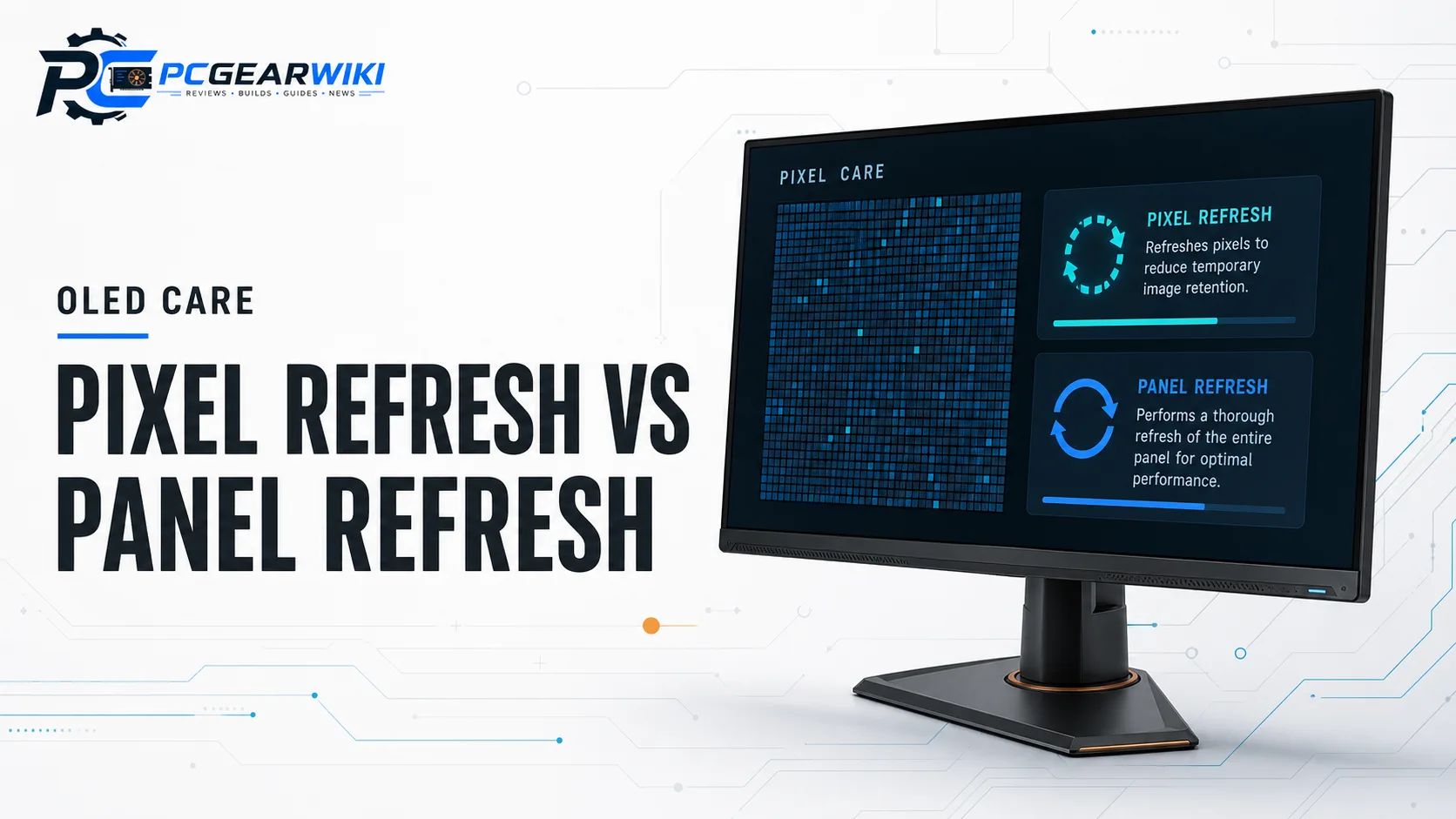
Quick answer: OLED Pixel Refresh vs Panel Refresh should be decided by verified specifications, compatibility, measurable performance, reliability, warranty, and current value. The practical winner changes with the intended workload, platform, physical constraints, and budget, so this comparison focuses on the trade-offs that affect real use rather than treating one specification as universally better.

Last updated: August 7, 2026

Table of Contents

5 sections 15 min read

If you are evaluating OLED gaming monitors in July 2026, understanding oled pixel refresh vs panel refresh is one of the most practical decisions you can make. Both features exist to reduce image retention and long-term burn-in risk on self-emissive panels, which matters for gamers who keep HUDs, chat overlays, or desktop taskbars on screen for long sessions.

This guide defines each process, compares how they differ in timing and intensity, and shows how leading brands package them inside broader OLED care systems. We also map the discussion to real monitor options across QHD, 4K, ultrawide, dual-mode, and high-refresh designs so you can choose protection features without sacrificing motion clarity or HDR impact. For a wider panel technology overview, start with our IPS vs OLED monitor buying guide.

1
-33%
Samsung Odyssey OLED G6 27" QD-OLED QHD 240Hz Gaming Monitor
Best Seller

Samsung Odyssey OLED G6 27" QD-OLED QHD 240Hz

9.6 /10
Editorial Score
This research-based editorial score summarizes product fit within this guide. It is not a laboratory measurement or a manufacturer rating. Learn more ›
$599.99 Save $200.00
$399.99
The Samsung 27-inch Odyssey OLED G6 is a QD-OLED QHD monitor with 240Hz refresh rate and 0.03ms GtG response. It suits gamers seeking vibrant imagery, fast performance, and burn-in safeguards in a compact form factor.
Pros & Cons

Pros

  • Vivid color gamut and deep black levels for immersive experiences
  • Ultra-fast performance ideal for esports and high-speed gaming
  • Robust burn-in protection features extend panel longevity
  • Premium metal construction with flexible ergonomics
  • Accurate color reproduction suitable for content creation alongside gaming

Cons

  • Lacks built-in speakers requiring separate audio equipment
  • Limited connectivity without USB ports or additional inputs
  • Some protective features restricted to non-PC modes
2
-30%
Samsung Odyssey OLED G5 G50SF 27" QHD QD-OLED Gaming Monitor 180Hz 0.03ms G-Sync
Editor's Pick

Samsung Odyssey OLED G5 G50SF 27" QHD QD-OLED

9.9 /10
Editorial Score
This research-based editorial score summarizes product fit within this guide. It is not a laboratory measurement or a manufacturer rating. Learn more ›
$499.99 Save $150.45
$349.54
This is a 27-inch QHD QD-OLED gaming monitor with 180Hz refresh rate and 0.03ms response time. It stands out for Pantone-validated color accuracy and OLED Safeguard burn-in prevention, suiting competitive gamers who need smooth, vibrant displays.
Pros & Cons

Pros

  • Exceptional response time and refresh rate for competitive edge
  • Strong color reproduction with Pantone validation
  • Built-in safeguards against common OLED issues like burn-in
  • Compatible with both NVIDIA and AMD sync technologies

Cons

  • New model lacks established user feedback on longevity
  • May require a high-end graphics card to maximize QHD performance at 180Hz
  • OLED brightness can vary in extremely lit environments despite glare reduction
3
-24%
MSI MPG 321URX QD-OLED 32 Inch 4K UHD 240Hz Quantum Dot Gaming Monitor
Limited Time

MSI MPG 321URX QD-OLED 32 Inch 4K UHD 240Hz

9.9 /10
Editorial Score
This research-based editorial score summarizes product fit within this guide. It is not a laboratory measurement or a manufacturer rating. Learn more ›
$1,049.99 Save $250.00
$799.99
The MSI MPG 321URX is a 32-inch 4K QD-OLED gaming monitor with 240Hz refresh rate and 0.03ms response time. It offers vibrant colors and true blacks, suiting competitive gamers and enthusiasts needing premium motion clarity.
Pros & Cons

Pros

  • Exceptional color vibrancy and true black levels from the QD-OLED panel
  • High 240Hz refresh rate supports competitive 4K gaming
  • Versatile ports including 90W USB-C power delivery and HDMI 2.1
  • Silent fanless design with effective thermal management
  • Ergonomic 4-way stand and smart app-based controls

Cons

  • OLED technology carries inherent burn-in risk with prolonged static images
  • Text clarity can require optimization for productivity tasks
  • Advanced features may demand initial calibration for best results
4
-13%
MSI MAG 274QP QD-OLED X24 27-Inch WQHD 240Hz 0.03ms Quantum Dot OLED Gaming Monitor Adaptive-Sync HDMI 2.1
Top Rated

MSI MAG 274QP QD-OLED X24 27-Inch WQHD 240Hz

9.8 /10
Editorial Score
This research-based editorial score summarizes product fit within this guide. It is not a laboratory measurement or a manufacturer rating. Learn more ›
$399.99 Save $50.00
$349.99
The MSI MAG 274QP QD-OLED X24 is a 27-inch WQHD Quantum Dot OLED gaming monitor with 240Hz refresh rate and 0.03ms response time. Its elite motion clarity and 99% DCI-P3 color performance make it ideal for competitive gamers seeking premium visuals and tear-free play.
Pros & Cons

Pros

  • Industry-leading 240Hz refresh and 0.03ms GtG response deliver exceptional motion clarity for fast-paced gaming
  • QD-OLED panel produces infinite contrast, deep blacks, and highly accurate 10-bit color with Delta E ≤2
  • Built-in Adaptive-Sync supports both AMD FreeSync Premium and NVIDIA G-SYNC Compatible for smooth tear-free play
  • OLED Care 2.0 suite plus advanced graphene heatsink enhance panel longevity and durability
  • Ergonomic stand with full tilt height swivel pivot adjustments and versatile high-bandwidth connectivity

Cons

  • OLED technology still carries a risk of temporary image retention or burn-in with prolonged static content despite protective software
  • Peak brightness limited to 400 nits may reduce HDR impact or outdoor-room visibility compared to brighter LCD alternatives
  • 26.5-inch screen size prioritizes focus over expansive multitasking real estate preferred by some productivity users
Specifications

Panel Type: 26.5-inch Quantum Dot OLED with anti-glare coating

Resolution: 2560 x 1440 WQHD (16:9)

Refresh Rate: 240Hz

Response Time: 0.03ms GtG

Color Depth: 10-bit, 1.07 billion colors, 99% DCI-P3, Delta E ≤2

Brightness: Up to 400 nits peak

Contrast Ratio: 1,500,000:1 native

Adaptive Sync: AMD FreeSync Premium, NVIDIA G-SYNC Compatible

Ports: DisplayPort 1.4a, HDMI 2.1 with CEC

Stand: 4-way adjustable (height, tilt, swivel, pivot), VESA 100mm

Extra Features: MSI OLED Care 2.0, AI Vision, Less Blue Light Pro, Smart Crosshair, Gaming Intelligence software

5
-45%
LG 32GX850A-B 32" UltraGear 4K UHD OLED Gaming Monitor Dual-Mode 165Hz/330Hz

LG 32GX850A-B 32" UltraGear 4K UHD OLED

9.4 /10
Editorial Score
This research-based editorial score summarizes product fit within this guide. It is not a laboratory measurement or a manufacturer rating. Learn more ›
$1,299.99 Save $580.00
$719.99
The LG 32GX850A-B is a 32-inch 4K UHD glossy OLED gaming monitor with dual-mode 165Hz/330Hz refresh rates and 0.03ms response time. Its standout quality is the OLED panel's contrast and color combined with mode-switching versatility, suited for gamers needing both immersive story-driven play and competitive speed.
Pros & Cons

Pros

  • Exceptional contrast and deep blacks from the OLED panel enhance visibility in dark scenes
  • Dual refresh rate modes provide genuine flexibility across gaming genres without compromise
  • Fully adjustable stand supports precise positioning for extended comfortable sessions
  • Fast response time delivers clear motion with minimal artifacts

Cons

  • Glossy screen surface is prone to reflections in rooms with strong ambient lighting
  • Maximum refresh rates require a high-end graphics card with DisplayPort 2.1 or HDMI 2.1 support
  • Static on-screen elements like HUDs carry typical OLED burn-in risk over very long periods
6
-36%
Acer Predator X27U 26.5" WQHD QD-OLED 240Hz Gaming Monitor AMD FreeSync

Acer Predator X27U 26.5" WQHD QD-OLED 240Hz

9.5 /10
Editorial Score
This research-based editorial score summarizes product fit within this guide. It is not a laboratory measurement or a manufacturer rating. Learn more ›
$549.99 Save $200.00
$349.99
The Acer Predator X27U is a 26.5-inch WQHD QD-OLED monitor with 240Hz refresh rate and 0.03ms response time. It delivers fast performance and vibrant colors for competitive gamers needing smooth tear-free gameplay.
Pros & Cons

Pros

  • QD-OLED panel delivers superior contrast and color accuracy for immersive visuals.
  • High refresh rate and fast response enable precise aiming and fluid motion in competitive games.
  • Ergonomic stand supports multiple adjustments for comfortable extended use.
  • Strong connectivity options integrate well with modern gaming PCs and consoles.

Cons

  • OLED technology carries a risk of burn-in with prolonged static images like HUDs.
  • The 26.5-inch size may feel limited compared to larger monitors for some users.
  • Full 240Hz performance requires a powerful graphics card at WQHD resolution.
7

ASUS ROG Strix XG32UCWMG 32 Inch 4K OLED

9.5 /10
Editorial Score
This research-based editorial score summarizes product fit within this guide. It is not a laboratory measurement or a manufacturer rating. Learn more ›
The ASUS ROG Strix XG32UCWMG is a 32-inch 4K OLED gaming monitor with dual-mode refresh rates of 4K@240Hz or FHD@480Hz. Its TrueBlack Glossy panel and Neo Proximity Sensor burn-in protection suit competitive gamers needing sharp visuals and high responsiveness.
Pros & Cons

Pros

  • Superior contrast ratio and 0.03ms response time deliver immersive gaming without motion blur.
  • Flexible dual refresh rate options adapt to different gaming needs.
  • Robust suite of OLED protection technologies extends panel life.
  • Multiple connectivity choices support modern multi-device setups.

Cons

  • The glossy display surface can pick up reflections from ambient light sources.
  • Despite protections, OLED burn-in may still occur with prolonged static content display.
  • Mode switching requires manual intervention via hotkey.
8
-15%
ASUS ROG Swift PG27AQDP 27" 1440p 480Hz OLED Gaming Monitor with AI Assistant

ASUS ROG Swift PG27AQDP 27" 1440p 480Hz OLED

9.5 /10
Editorial Score
This research-based editorial score summarizes product fit within this guide. It is not a laboratory measurement or a manufacturer rating. Learn more ›
$799.00 Save $120.00
$679.00
The ASUS ROG Swift PG27AQDP is a 27-inch 1440p WOLED monitor with a 480Hz refresh rate and 0.03ms response time. Its standout quality is ultra-responsive performance suited for esports competitors who prioritize smoothness and color vibrancy.
Pros & Cons

Pros

  • Industry-first 480Hz speed delivers unmatched responsiveness for esports
  • Advanced cooling and software protections extend OLED panel lifespan
  • AI tools provide practical in-game assistance without extra software
  • Strong color gamut and anti-flicker tech support vivid, stable images
  • Flexible connectivity handles modern consoles and PCs effectively

Cons

  • Burn-in prevention still requires user attention to static content habits
  • AI assistant features may need manual tuning for optimal results in every game
  • High refresh rate advantages are limited outside of competitive esports titles
9

wisecoco 7 Inch FHD AMOLED Touch Display

wisecoco
9.6 /10
Editorial Score
This research-based editorial score summarizes product fit within this guide. It is not a laboratory measurement or a manufacturer rating. Learn more ›
The wisecoco 7-inch FHD AMOLED touch display is a compact HDMI screen with 90Hz refresh, 850-nit brightness, and rich 10-bit color. It is best for Raspberry Pi builds, DIY projects, mini PCs, and portable gaming setups that need a vivid small display.
Pros & Cons

Pros

  • Bright AMOLED display with strong contrast and vivid color reproduction
  • Smooth 90Hz refresh rate is a notable upgrade over many small project screens
  • Full HD resolution is crisp for a 7-inch panel
  • HDMI compatibility makes it flexible for Raspberry Pi, mini PCs, consoles, and custom electronics
  • Very slim panel profile supports compact DIY integrations

Cons

  • Touch functionality may vary depending on the connected console or host device
  • Small 7-inch size may feel cramped for desktop productivity or detailed design work
  • Requires proper mounting, power, and enclosure planning for polished DIY installations
Specifications

Display size: 7 inches

Resolution: Full HD 1920x1080

Panel type: AMOLED touch display

Refresh rate: 90Hz default

Brightness: Up to 850 nits

Color: 10-bit color depth, 1.07 billion colors, 100% NTSC

Input: HDMI via included driver board

Touch: On-cell capacitive multi-touch, device support may vary

Use cases: Raspberry Pi, mini PCs, handheld game consoles, PS4/PS5 display projects, camera systems, industrial panels, and DIY screens

Buyer Guide

Choose this display if your priority is image quality in a compact format. The AMOLED panel, high brightness, and 90Hz refresh rate make it better suited for premium DIY builds than basic low-cost LCD screens.

Before buying, confirm that your host device supports HDMI output and that your project can accommodate the driver board, power requirements, cables, and mounting method. If touch control is important, verify compatibility with your operating system or console because touch support can vary.

This screen is ideal for experienced hobbyists, Raspberry Pi builders, and portable gaming modders. If you need a ready-to-use monitor with a case, stand, speakers, and simple desktop ergonomics, a finished portable monitor may be more convenient.

10

ASUS ROG Swift PG27AQWP-W 27" OLED Dual-Mode

9.8 /10
Editorial Score
This research-based editorial score summarizes product fit within this guide. It is not a laboratory measurement or a manufacturer rating. Learn more ›
The ASUS ROG Swift PG27AQWP-W is a 26.5-inch dual-mode OLED gaming monitor that delivers QHD at 540Hz or HD at 720Hz with a 0.02ms response time. Its Tandem OLED panel, TrueBlack Glossy surface, and Neo Proximity Sensor burn-in protection make it a top pick for competitive esports players and high-refresh enthusiasts.
Pros & Cons

Pros

  • Extreme dual-mode refresh rates up to 720Hz give a clear competitive edge
  • Exceptional OLED contrast, 99.5% DCI-P3 color, and TrueBlack Glossy clarity
  • Advanced multi-layer burn-in protection including Neo Proximity Sensor and 3-year coverage
  • Future-proof DisplayPort 2.1a connectivity and robust cooling design
  • Fully adjustable ergonomic stand plus useful AI gaming assists

Cons

  • Full 720Hz mode requires dropping to HD resolution, which not all users will prefer
  • OLED panels retain a residual long-term burn-in risk even with strong safeguards
  • High-end esports focus makes it overkill for casual or productivity-oriented buyers
Key Specifications

Display: 26.5-inch QHD Tandem OLED with TrueBlack Glossy panel

Dual-mode refresh: QHD at 540Hz or HD at 720Hz

Response time: 0.02ms gray-to-gray

Contrast and color: 1.5M:1, VESA DisplayHDR 500 True Black, 99.5% DCI-P3, true 10-bit, Delta E less than 2

Adaptive sync: NVIDIA G-SYNC Compatible, AMD FreeSync Premium Pro

Protection: ASUS OLED Care Pro with Neo Proximity Sensor, pixel cleaning, screen move, logo and taskbar dimming

Connectivity: DisplayPort 2.1a UHBR20 (80Gbps), HDMI 2.1

Ergonomics: Tilt, swivel, pivot, height adjustable stand; VESA mount ready

Warranty: 3 years with advanced replacement and burn-in coverage

11
-36%
Samsung Odyssey G8 27-Inch QD-OLED 4K Gaming Monitor 240Hz 0.03ms FreeSync Premium Pro Glare Free

Samsung Odyssey G8 27-Inch QD-OLED 4K

9.5 /10
Editorial Score
This research-based editorial score summarizes product fit within this guide. It is not a laboratory measurement or a manufacturer rating. Learn more ›
$1,299.99 Save $467.99
$832.00
The Samsung 27-inch Odyssey QD-OLED G8 is a 4K 240Hz gaming monitor with 0.03ms response and advanced burn-in protection. Its high 166 PPI panel and glare-free tech make it ideal for competitive gamers wanting sharp, smooth visuals without reflections.
Pros & Cons

Pros

  • Stunning 4K QD-OLED clarity and color depth with industry-leading pixel density on a 27-inch screen
  • Ultra-fast 240Hz and near-instant 0.03ms GtG response deliver seamless high-frame-rate gaming
  • Effective multi-layer burn-in safeguards including dynamic cooling and thermal modulation
  • Glare Free surface keeps the image clear even in bright rooms
  • Fully adjustable ergonomic stand plus ambient CoreLighting+ for customized immersion

Cons

  • No built-in speakers so external audio is required for full sound
  • Lacks smart interface or USB hub ports found on some rival gaming monitors
  • OLED technology still carries a residual burn-in risk for users with mostly static desktop content
Specifications

Panel Technology: 27-inch QD-OLED with Glare Free coating and 166 PPI density.

Resolution and Speed: 4K UHD (3840 x 2160) at 240Hz refresh rate with 0.03ms GtG response time.

HDR and Sync: VESA DisplayHDR True Black 400, AMD FreeSync Premium Pro, G-Sync Compatible.

Protection Systems: Safeguard+ Dynamic Cooling with Pulsating Heat Pipe, Thermal Modulation, Logo and Taskbar Detection.

Design and Connectivity: Premium metal chassis with CoreSync and CoreLighting+, ergonomic stand for tilt and height, HDMI and DisplayPort inputs. No built-in speakers or smart interface.

12
-5%
AOC Q27GAZDV 27 Inch QD-OLED Gaming Monitor 1440p QHD 240Hz 0.03ms HDMI 2.1 G-SYNC Compatible HDR

AOC Q27GAZDV 27 Inch QD-OLED Gaming Monitor 1440p

AOC
9.9 /10
Editorial Score
This research-based editorial score summarizes product fit within this guide. It is not a laboratory measurement or a manufacturer rating. Learn more ›
$379.99 Save $20.00
$359.99
The AOC Q27GAZDV is a 27-inch QD-OLED gaming monitor delivering 1440p QHD at 240Hz with 0.03ms response. Its standout quality is infinite contrast and vivid colors from QD-OLED tech, ideal for competitive PC and console gamers wanting tear-free immersion.
Pros & Cons

Pros

  • Exceptional QD-OLED picture with true blacks, infinite contrast, and wide color gamut for immersive visuals
  • Blazing 240Hz refresh rate paired with 0.03ms response delivers buttery-smooth competitive performance
  • Full HDMI 2.1 and DisplayPort connectivity ensures high-refresh gaming across PC and next-gen consoles
  • Highly ergonomic stand with full adjustability plus built-in USB hub boosts everyday usability
  • G-SYNC Compatible support effectively reduces tearing and stuttering for responsive gameplay

Cons

  • OLED technology carries a risk of burn-in if static UI elements are displayed for extended periods
  • 27-inch 1440p size may feel limited for users seeking larger screens or 4K resolution
  • No built-in speakers means external audio is required for full multimedia use
Key Specifications

Panel: 27-inch QD-OLED with true blacks and infinite contrast. Resolution: QHD 2560x1440. Refresh Rate: 240Hz. Response Time: 0.03ms. Color: 147% sRGB / 110% DCI-P3. Adaptive Sync: G-SYNC Compatible. Connectivity: HDMI 2.1, DisplayPort 1.4, USB 3.2 hub. Stand: Height, tilt, swivel, pivot adjustable. Additional: HDR True Black, Flicker-Free, VESA mount ready.

These specs combine to deliver high-performance gaming and content creation capabilities in a compact yet versatile package suited for desks of varying sizes.

13
-6%
Alienware AW3425DW 34" 240Hz QD-OLED Curved Gaming Monitor 1800R WQHD

Alienware AW3425DW 34" 240Hz QD-OLED Curved

Alienware
9.8 /10
Editorial Score
This research-based editorial score summarizes product fit within this guide. It is not a laboratory measurement or a manufacturer rating. Learn more ›
$799.99 Save $50.00
$749.99
The Alienware AW3425DW is a 34.2-inch WQHD QD-OLED curved monitor with 240Hz refresh rate and 0.03ms response time. It provides top-tier color accuracy and motion smoothness for competitive gamers seeking ultrawide immersion.
Pros & Cons

Pros

  • Outstanding DCI-P3 color coverage with precise accuracy
  • Ultra-responsive motion handling for competitive advantage
  • Curved ultrawide design boosts field of view immersion
  • Multiple adaptive sync technologies ensure smooth gameplay

Cons

  • Burn-in remains a consideration for static content use despite protections
  • Demands high-end GPU to maximize full refresh rate potential
  • Large footprint requires substantial desk space

OLED Pixel Refresh vs Panel Refresh: How They Work and Why They Matter

Pixel refresh and panel refresh are complementary maintenance cycles, not competing marketing names for the same button. On current OLED gaming displays, manufacturers usually run a lighter pixel-level compensation cycle more often and reserve a deeper panel-level refresh for longer cumulative use. Knowing which process is automatic, which one can interrupt gaming, and which one is paired with sensors or thermal control helps you keep infinite contrast without constant anxiety about static UI elements.

What OLED Pixel Refresh Actually Does

Pixel refresh is a compensation cycle that recalibrates subpixel behavior after a period of use. According to manufacturer descriptions across QD-OLED and WOLED gaming monitors, it is designed to correct minor uniformity drift and reduce short-term image retention from repeated bright UI elements. It is typically shorter and less disruptive than a full panel refresh, which is why many monitors schedule it after you power the display down or after a set number of operating hours.

For competitive play, the important point is timing. If a monitor forces a pixel refresh while you are mid-session, you may see a brief black screen or a short wait before the panel becomes usable again. Better implementations let the process finish when the display is idle, after the system enters standby, or when a proximity sensor detects that you have left the desk. When you compare oled pixel refresh vs panel refresh, treat pixel refresh as the frequent, lighter maintenance pass.

Practical recommendation: prefer models that document OLED care software, automatic scheduling, and clear user prompts. Displays such as the ASUS ROG Strix and Swift OLED lines advertise OLED Care Pro tools and a Neo Proximity Sensor that can switch the screen to black when you walk away, which reduces the chance that a static image remains parked on the panel during breaks.

What OLED Panel Refresh Is and When It Runs

Panel refresh, sometimes described by brands as a deeper compensation, full-panel refresh, or image retention refresh, is a more thorough cycle. Manufacturer materials position it as the process that more aggressively realigns the panel after longer cumulative runtime. Because it is more intensive, it usually takes longer than a pixel refresh and is intended to run less often.

This is the feature gamers notice most when a monitor refuses to wake until a maintenance cycle completes. That interruption is annoying during a ranked match, but it is also evidence that the display is attempting to protect long-term uniformity. Acer’s Predator X27U documentation specifically calls out image retention-refresh behavior, while Samsung Odyssey OLED models emphasize OLED Safeguard thermal modulation as part of a broader strategy to keep the panel cooler and more stable under load.

Real-world usage example: if you leave a bright Discord window, browser toolbar, or console dashboard parked for hours every day, the panel refresh cycle is your second line of defense after good desktop hygiene. Hide static bars when possible, enable screen savers or auto-hide taskbars, and allow the monitor to complete scheduled maintenance instead of hard-powering it off mid-cycle.

Key Differences: Frequency, Intensity, and User Impact

When you compare oled pixel refresh vs panel refresh side by side, three differences matter most: frequency, depth of correction, and how often the process can interrupt use. Pixel refresh is the more frequent, shorter cycle aimed at routine compensation. Panel refresh is the deeper, less frequent cycle intended to address longer-term retention risk. Neither replaces basic usage habits, and neither is a substitute for warranty coverage that explicitly includes burn-in.

Brand packaging also differs. ASUS pairs care routines with proximity sensing and DisplayWidget Center controls. MSI markets OLED Care 2.0 alongside Gaming Intelligence features on the MPG 321URX QD-OLED. Samsung highlights OLED Safeguard and glare-free coatings on Odyssey OLED G5 and G6 models. LG UltraGear OLEDs emphasize glossy contrast, dual-mode refresh rates, and multi-certification eye-care claims. The names change, but the buyer goal is the same: automatic compensation plus tools that reduce static content dwell time.

Decision rule: if you primarily play story-driven single-player games with varied imagery, almost any modern OLED care suite is adequate when used correctly. If you stream with fixed overlays, edit timelines with constant UI chrome, or leave desktop icons visible for work and play, prioritize monitors with clear care software, proximity sensors, thermal safeguards, and multi-year burn-in coverage where offered.

Panel Technology, Brightness, and Retention Risk

Pixel and panel refresh matter more on OLED than on LCD because each pixel emits its own light. That architecture delivers infinite contrast and near-instant response, but static bright content ages organic materials unevenly if left unchecked. QD-OLED and WOLED implementations both rely on care routines, yet they present different brightness and coating trade-offs that influence how carefully you need to manage static UI.

Based on available product data, Samsung Odyssey OLED G6 and G5, Acer Predator X27U, MSI MPG 321URX, and Alienware AW3425DW use QD-OLED panels with strong color volume claims and HDR-focused feature sets. ASUS ROG Strix XG32UCWMG, ROG Swift PG27AQDP, and PG27AQWP-W emphasize WOLED or Tandem OLED approaches with TrueBlack glossy finishes, dual-mode high refresh rates, and OLED Care Pro tooling. LG’s 32GX850A-B uses a glossy OLED stack with dual-mode 4K/FHD switching and VESA DisplayHDR True Black 400 certification.

If your room has bright windows, glare-free coatings on some Samsung models can keep reflections under control without forcing extreme static brightness. If you want maximum punch for dark-room HDR, glossy TrueBlack-style panels can look more dimensional, but they also make reflections more visible and can encourage higher sustained APL scenes. In both cases, let pixel refresh and panel refresh complete on schedule and avoid parking bright white windows in the same corner of the screen for days at a time. For more HDR context, read Is HDR Worth It For Gaming Monitors?.

Refresh Rate, Response Time, and Motion Clarity

OLED care features protect longevity, but most buyers still choose these monitors for motion. Manufacturer specifications across the eligible set commonly list 0.03 ms GtG response times, with the ASUS ROG Swift PG27AQWP-W claiming 0.02 ms and dual-mode peaks up to QHD 540Hz or HD 720Hz. Other standouts include the PG27AQDP at 480Hz QHD, multiple 240Hz QD-OLED options, LG dual-mode 165Hz 4K / 330Hz FHD, and the ASUS XG32UCWMG dual-mode 4K 240Hz / FHD 480Hz design.

Higher refresh rates do not remove the need for pixel refresh or panel refresh, but they do change the user experience around interruptions. Competitive players who live at 240Hz to 540Hz should confirm whether care cycles can be deferred until idle and whether anti-flicker features help during VRR fluctuations. ASUS specifically markets OLED anti-flicker behavior on the PG27AQDP, while FreeSync Premium, FreeSync Premium Pro, G-SYNC Compatible, and AdaptiveSync support appear across several models to keep frame pacing smooth.

If you are coming from a 144Hz IPS panel, the jump in clarity is usually more about near-instant pixel response and perfect blacks than about care algorithms alone. Still, pair the motion upgrade with sensible maintenance habits so the panel stays uniform. Our 144Hz gaming monitor buying guide remains useful if you are comparing older high-refresh LCDs against current OLED options.

Resolution, Size, Dual-Mode Flexibility, and Use Case Fit

Resolution and size change how noticeable static UI becomes and how often you may benefit from dual-mode switching. 26.5-inch to 27-inch QHD OLEDs such as the Samsung Odyssey OLED G6, Acer Predator X27U, and ASUS PG27AQDP keep desktop icons and HUDs relatively compact, which is ideal for FPS and esports focus. 32-inch 4K models like the LG 32GX850A-B, ASUS XG32UCWMG, and MSI MPG 321URX deliver denser text and more immersive single-player detail, while the Alienware AW3425DW stretches immersion further with a 34-inch 3440×1440 1800R curve.

Dual-mode designs are especially relevant when you care about both fidelity and competitive speed. LG’s UltraGear 32GX850A-B switches between 4K 165Hz and Full HD 330Hz. ASUS XG32UCWMG targets 4K 240Hz or FHD 480Hz. The PG27AQWP-W goes further with QHD 540Hz or HD 720Hz according to manufacturer claims. These modes do not replace oled pixel refresh vs panel refresh maintenance, but they do let one panel serve story-driven and high-frame-rate play without buying two monitors.

Size choice also interacts with desk ergonomics and multitasking. Ultrawide layouts can place chat or capture software on the far edge of the panel for hours, which is exactly the scenario where proximity sensors, auto-hide UI, and scheduled panel refresh become valuable. If you are still deciding between common desktop footprints, see our 27 inch vs 32 inch monitor buying guide.

Warranty, Software, and Daily Habits That Matter More Than Marketing Names

Brand wording around pixel refresh and panel refresh only helps if the rest of the ownership package is solid. Look for multi-year warranties that mention burn-in or advanced replacement where available, care software you will actually open, and physical design choices such as heatsinks or thermal modulation. ASUS advertises custom heatsink designs and three-year coverage with burn-in language on selected Swift OLED models. Samsung lists a three-year warranty on the Odyssey OLED G6. MSI promotes OLED Care 2.0. These are specification and policy claims, not guarantees of zero retention under abuse.

Daily habits still dominate outcomes. Hide the taskbar, dim static overlays, enable auto-hide for sidebars, avoid maxed white backgrounds for office work all day, and allow the monitor to finish maintenance when prompted. Variable refresh rate support is also worth enabling for comfort; if you need a primer on adaptive sync terminology, review What Is VRR On A Gaming Monitor?.

Bottom line for buyers: treat oled pixel refresh vs panel refresh as two layers of automated compensation. Choose a monitor whose care suite matches your workflow, then protect the panel with software settings and common-sense content variety. That combination matters more than memorizing every marketing label.

Technical Comparison of Notable OLED Gaming Monitors

The table below summarizes manufacturer-stated traits for eligible OLED gaming monitors from the product set. Use it to match care-oriented features with resolution, refresh rate, and intended use. Prices are omitted because they change frequently.

ModelPanel / ResolutionMax Refresh (spec)OLED Care HighlightBest For
LG 32GX850A-B32″ glossy OLED, 4K165Hz 4K / 330Hz FHD dual-modeDual-mode speed with True Black 400 HDR focusMixed cinematic and competitive play
Samsung Odyssey OLED G627″ QD-OLED, QHD240HzOLED Safeguard thermal modulation, glare-freeBalanced QHD gaming value
ASUS ROG Strix XG32UCWMG32″ TrueBlack glossy WOLED, 4K240Hz 4K / 480Hz FHD dual-modeOLED Care Pro with Neo Proximity SensorHigh-end dual-mode 4K setups
Acer Predator X27U26.5″ QD-OLED, WQHD240HzImage retention-refresh emphasisCompact esports-style immersion
MSI MPG 321URX QD-OLED31.5″ QD-OLED, 4K240HzOLED Care 2.0, USB-C productivity extras4K gaming plus desktop versatility
Alienware AW3425DW34″ QD-OLED ultrawide, 3440×1440240HzTrueBlack 400 HDR with adaptive sync stackImmersive ultrawide gaming
ASUS ROG Swift PG27AQDP26.5″ WOLED, QHD480HzOLED care tooling plus anti-flicker focusHigh-refresh competitive play
ASUS ROG Swift PG27AQWP-W26.5″ Tandem OLED, QHD540Hz QHD / 720Hz HD dual-modeOLED Care Pro, Neo Proximity SensorEnthusiast peak-refresh setups
Samsung Odyssey OLED G527″ QD-OLED, QHD180HzOLED Safeguard and glare-free coatingAccessible OLED entry point

Why You Should Trust PCGearWiki

PCGearWiki builds monitor guidance from specification research, feature comparison, compatibility checks, and value assessment rather than hype. For topics like oled pixel refresh vs panel refresh, we separate manufacturer claims about care cycles, refresh rates, HDR certifications, and warranty language from unverifiable marketing adjectives. That approach keeps recommendations grounded in what the products actually document.

We also evaluate how features map to real buyer scenarios: competitive FPS, single-player immersion, ultrawide multitasking, dual-mode flexibility, and creator-friendly color claims. When affiliate relationships exist, they never change the underlying eligibility rules. If a product is a poor fit for the keyword constraints, we exclude it even when it is popular. For more on how we structure hardware guidance, see our review methodology.

Our goal is simple: help PC builders, gamers, and creators make a confident OLED purchase with fewer surprises after the first month of ownership. That means explaining maintenance features clearly, highlighting trade-offs, and pointing you toward models whose strengths match your desk, GPU, and game library.

Final Thoughts

Choosing between monitors is easier once you treat oled pixel refresh vs panel refresh as complementary protection layers instead of mysterious black-box routines. Buy the panel format you actually need, confirm the care suite and warranty posture, then let automated maintenance do its job while you avoid static abuse. Below are scenario-based picks drawn only from the eligible OLED gaming monitors in the product data.

Best Overall: MSI MPG 321URX QD-OLED

The MSI MPG 321URX is a strong overall choice for gamers who want 4K QD-OLED clarity, 240Hz motion, True Black 400 positioning, and a mature OLED Care 2.0 feature set. It also includes productivity-friendly extras such as USB Type-C connectivity and KVM-oriented functionality according to manufacturer materials. Ideal user: someone stepping up from a 27-inch LCD who wants one premium desktop centerpiece for games and work. Trade-off: it is a larger, higher-tier 4K panel, so you need a GPU that can feed it well.

Best Value: Samsung 27″ Odyssey OLED G6

The Odyssey OLED G6 balances QHD sharpness, 240Hz speed, glare-free coating, Pantone-validated color claims, and OLED Safeguard thermal features at a more approachable tier than flagship 4K dual-mode screens. Ideal user: FPS and multiplayer players who want OLED contrast without moving to 32-inch 4K. Trade-off: it is not a dual-mode 4K display, so creators who need maximum desktop density may prefer a 32-inch UHD model.

Best Budget: Acer Predator X27U

Among the eligible set, the Acer Predator X27U stands out as a compact 26.5-inch WQHD QD-OLED with 240Hz, 0.03 ms response claims, FreeSync Premium, and explicit image retention-refresh messaging. Ideal user: competitive players who want OLED motion in a denser esports-friendly size. Trade-off: you give up the dual-mode 4K flexibility and ultrawide immersion found on pricier alternatives.

Best Premium / Enthusiast Pick: ASUS ROG Strix XG32UCWMG

For enthusiasts who want maximum versatility, the ASUS ROG Strix XG32UCWMG pairs a 32-inch 4K TrueBlack glossy WOLED panel with dual-mode 4K 240Hz / FHD 480Hz operation, OLED Care Pro, and a Neo Proximity Sensor. Ideal user: mixed-genre gamers and creators who want both high-fidelity single-player visuals and extreme competitive headroom. Trade-off: premium feature density means a higher spend and more settings to manage. If ultrawide immersion is your priority instead, the Alienware AW3425DW remains a compelling curved QD-OLED alternative.

If you are still browsing the wider category, explore our best OLED gaming monitor recommendations and the full Best Gaming Monitors hub for adjacent shortlists.

Frequently Asked Questions

What is the difference between OLED pixel refresh and panel refresh?

Pixel refresh is the lighter, more frequent compensation cycle that helps correct short-term uniformity and retention issues. Panel refresh is a deeper, less frequent maintenance process intended for longer cumulative use. Together they form the automated care layer that helps OLED gaming monitors manage static content stress over time.

Does pixel refresh or panel refresh completely prevent burn-in?

No. These cycles reduce risk and correct minor retention, but they do not make an OLED immune to permanent image retention under heavy static use. Varied content, dimmed overlays, auto-hide UI, and allowing maintenance cycles to finish still matter. Warranty terms that mention burn-in coverage add another ownership safety net when available.

Should competitive gamers worry about care cycles interrupting matches?

You should understand the timing, not fear the feature. Better implementations schedule maintenance when the display is idle, powered down, or when a proximity sensor detects that you left the desk. If you play long sessions daily, choose models with clear OLED care controls and avoid postponing prompted cycles for weeks at a time.

Which OLED monitor features matter as much as refresh cycles?

Refresh rate, response time, resolution, coating type, HDR certification, adaptive sync support, and warranty language all affect daily satisfaction. A 240Hz or dual-mode panel with strong care software is usually a better ownership experience than a slightly cheaper OLED with vague maintenance tools. For category browsing, visit the Best Gaming Monitors section on PCGearWiki.

Is an OLED still worth it if I use my PC for work and gaming?

Yes for many users, provided you manage static desktop elements thoughtfully. Enable auto-hide taskbars, avoid leaving bright windows parked for hours, and allow pixel refresh and panel refresh to complete. Creators who need dense text and accurate color can do very well on 4K OLEDs, while competitive players may prefer 27-inch QHD high-refresh models.

Sources and Verification

Research basis: Product identity, dimensions, interfaces, supported features, and warranty terms are checked against available manufacturer documentation and current retailer listings. Price, stock, and aggregate customer ratings can change after publication.

Testing disclosure: Unless this article explicitly states that PCGearWiki performed hands-on testing and describes the test setup, recommendations are research-based editorial evaluations rather than PCGearWiki laboratory measurements. Customer feedback is used to identify recurring ownership patterns, not as proof of technical performance.

Last source review: August 7, 2026. See our Review Methodology, Editorial Policy, and Corrections Policy.