

Last updated: September 22, 2026
The Crucial P3 Plus is a mainstream PCIe 4.0 NVMe SSD aimed at large game libraries, everyday upgrades, and users moving from SATA or older PCIe 3.0 storage. Its headline sequential read speed reaches up to 5,000 MB/s, but the important buying questions are sustained-write behavior, capacity, endurance, price, and workload.
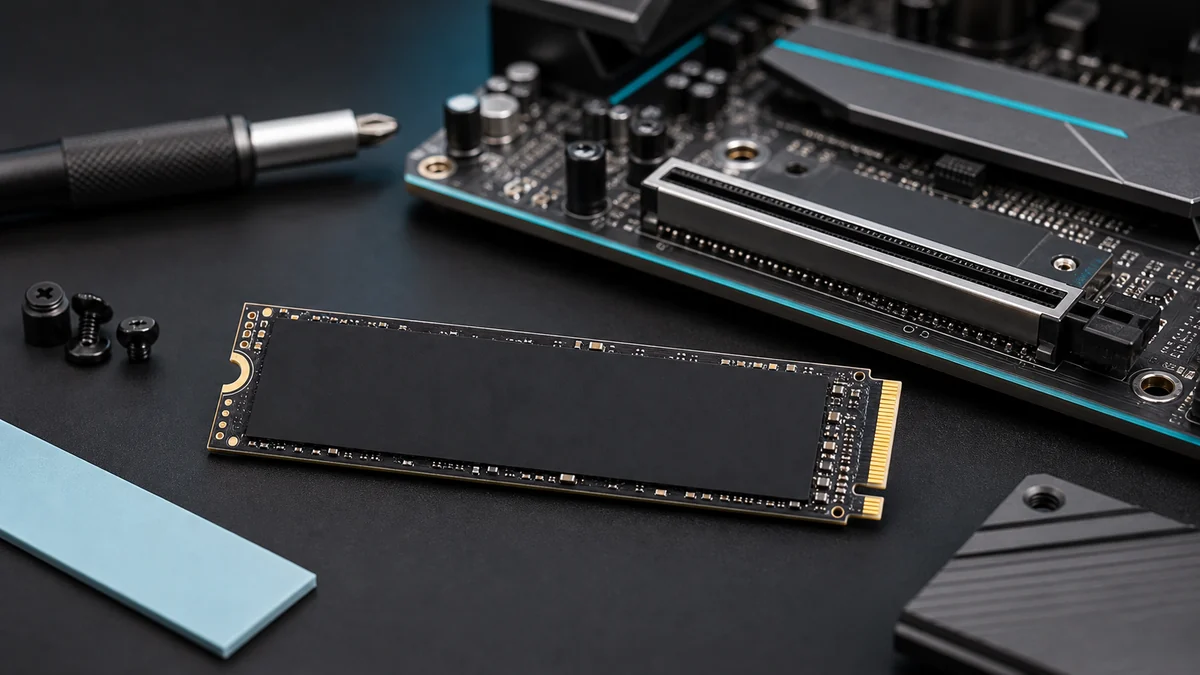
This is not positioned as a premium workstation drive. It uses a value-focused design that is better suited to reads, application loading, and bursty consumer writes than continuous large-file creation. Buyers should compare the current price with TLC-based alternatives before deciding.
| Specification | What to know |
|---|---|
| Interface | PCIe 4.0 NVMe, backward compatible at lower link speed |
| Form factor | M.2 2280 |
| Rated read speed | Up to 5,000 MB/s, depending on capacity |
| NAND class | Value-oriented QLC design |
| Warranty | Five years or the published TBW limit, whichever occurs first |

Pros
- High read speeds for responsive everyday use
- Simple installation in compatible systems
- Includes useful software bundle for setup
- Proven reliability from major flash manufacturer
Cons
- Full speeds require PCIe Gen4 slot
- No DRAM cache may limit sustained heavy transfers
- Capacity reduced slightly by formatting overhead
| Digital Storage Capacity | 1 TB |
|---|---|
| Hard Disk Interface | NVMe |
| Connectivity Technology | NVMe |
| Additional Features | Compact |
| Hard Disk Form Factor | 2.5 Inches |
| Compatible Devices | This drive is compatible with desktops & laptops that accept PCIe NVMe Gen 4.0 drives |
| Specific Uses For Product | Business, Gaming, Personal |
| Read Speed | 5000 Megabytes Per Second |
| Media Speed | 4200 Megabytes Per Second |
| Cache Memory Installed Size | 1 TB |
Best suited to shoppers comparing internal solid state drives products who specifically need enjoy faster bootups and app launches with sequential read speeds reaching 5000MB/s, Store essential files and media on 1TB of reliable Gen4 NVMe space.
Before buying, compare the exact model’s compatibility, dimensions, core specifications, warranty, recurring owner feedback, and current price against other internal solid state drives options. Retailer availability and pricing can change after publication.
Crucial P3 Plus Specifications by Capacity
| Capacity | Sequential Read | Sequential Write | Endurance |
|---|---|---|---|
| 500GB | Up to 4,700MB/s | Up to 1,900MB/s | 110TBW |
| 1TB | Up to 5,000MB/s | Up to 3,600MB/s | 220TBW |
| 2TB | Up to 5,000MB/s | Up to 4,200MB/s | 440TBW |
| 4TB | Up to 4,800MB/s | Up to 4,100MB/s | 800TBW |
All versions use the M.2 2280 form factor and PCIe 4.0 NVMe interface. The figures above come from the official Crucial P3 Plus product flyer. Crucial measured its typical I/O figures under specified fresh-out-of-box conditions; system configuration and workload can produce different results.

What the P3 Plus Is Designed For
The P3 Plus targets mainstream storage rather than workstation-class sustained writes. Its strongest use cases are Windows and application storage, large game libraries, general productivity, and upgrades from SATA or slower PCIe 3.0 SSDs. The 2TB and 4TB capacities are especially relevant when cost per gigabyte matters more than benchmark leadership.
Its peak specifications are considerably faster than SATA, but an SSD’s sequential rating is not a direct prediction of game-loading time or everyday responsiveness. Small-file access, CPU processing, the operating system, and application behavior also affect the experience.
Gaming Performance and Capacity
The P3 Plus is fast enough to function as a primary gaming drive on a modern desktop. Games benefit from SSD latency and fast asset access, but most titles do not require a flagship Gen4 drive. For that reason, choosing 2TB instead of paying more for a smaller premium SSD can be the more useful upgrade for a large library.
The 500GB version is the weakest gaming value because its rated write speed is much lower than the larger models and formatted capacity fills quickly. The 1TB version suits a moderate library, while 2TB is the practical sweet spot. The 4TB model prioritizes capacity, although buyers should compare its current price with other high-capacity NVMe drives.
Sustained Writes and Creator Workloads
Dynamic write acceleration helps the drive deliver high burst performance while cache space is available. During a long write, performance can fall after that cache is exhausted. This matters more for repeated video ingest, large project exports, virtual machines, and scratch-disk work than for ordinary game installs and desktop use.
Creators with occasional large transfers can still use the P3 Plus effectively, particularly at 2TB or 4TB. Users who write hundreds of gigabytes every day should prioritize higher endurance and independently measured sustained-write behavior instead of choosing solely from the 5,000MB/s headline figure.
Endurance and Five-Year Warranty
Endurance scales from 110TBW at 500GB to 800TBW at 4TB. These ratings are adequate for typical consumer use but lower than some performance-oriented Gen4 SSDs. TBW is a warranty limit based on host writes, not an exact lifespan prediction.
Crucial provides a five-year limited warranty or coverage until the applicable TBW limit is reached, whichever comes first. A user writing large amounts of data should estimate annual writes before purchase. Regardless of endurance, important files require a separate backup.
Thermals and Power Considerations
The P3 Plus includes adaptive thermal protection and is rated for operation from 0°C to 70°C according to Crucial. Thermal protection may reduce speed to protect the drive when temperatures rise. A motherboard M.2 heatsink is useful in a warm desktop or beneath a graphics card, but ordinary burst workloads do not necessarily require a large aftermarket cooler.
Laptop buyers should confirm M.2 2280 clearance and NVMe support. Thin notebooks can have different thermal and power constraints, so compatibility with the connector alone does not guarantee identical performance to a desktop test platform.
Compatibility and Software
- Interface: PCIe 4.0 NVMe; performance is limited by the host slot.
- Form factor: M.2 2280 for compatible desktops and laptops.
- Older systems: Confirm that the M.2 slot supports NVMe and that the BIOS can boot from it.
- Management: Crucial Storage Executive supports health monitoring, firmware updates, and supported drive functions.
- Migration: Acronis True Image for Crucial can assist with cloning an existing Windows drive.
Crucial maintains installation and software resources on its P3 Plus support page. Back up important files before cloning or changing storage hardware.
Crucial P3 Plus Pros and Cons
Pros
- Up to 5,000MB/s published sequential reads
- Capacity options up to 4TB
- Useful value for game libraries and mainstream storage
- Five-year limited warranty
- Storage Executive and Acronis support
- Standard M.2 2280 compatibility
Cons
- Lower endurance than many performance-focused Gen4 drives
- Sustained writes can fall after dynamic cache is exhausted
- 500GB model has substantially lower rated write speed
- Peak sequential figures do not describe every workload
Who Should Buy the Crucial P3 Plus?
Choose the P3 Plus for a budget-conscious gaming PC, a high-capacity secondary drive, a general productivity system, or an upgrade from SATA and older NVMe storage. The 2TB model offers the most balanced combination of capacity and rated performance, while 4TB is attractive when a large single-drive library is the priority.
Choose another SSD for a write-heavy workstation, continuous large-file production, or any workload where high sustained performance and stronger endurance matter more than purchase price. Also compare current pricing because SSD value changes quickly.
How We Evaluated the Crucial P3 Plus
PCGearWiki evaluated the P3 Plus using Crucial’s capacity-specific specifications, endurance limits, warranty language, interface compatibility, thermal features, software support, and workload fit. We distinguish official peak specifications from measured performance and do not present this as hands-on testing. See our Review Methodology for the complete process.
Final Verdict
The Crucial P3 Plus is a sensible capacity-first Gen4 SSD when priced competitively. It is well suited to gaming libraries and everyday storage, particularly at 2TB. Its lower endurance and cache-dependent sustained writes are the trade-offs. Buyers should choose it for value and capacity, not because the 5,000MB/s headline makes it a workstation drive.
Frequently Asked Questions
Is the Crucial P3 Plus good for gaming?
Yes. It provides enough performance for modern game storage, and the 2TB or 4TB models can hold a large library. Game-loading results also depend on the CPU and game engine, so a more expensive flagship SSD may not create a proportionate improvement.
Which P3 Plus capacity should I choose?
Choose 1TB for a modest system, 2TB for the best balance of gaming capacity and performance, or 4TB when consolidating a very large library. The 500GB version has limited space and the lowest rated write speed.
Does the P3 Plus require a heatsink?
A large aftermarket heatsink is not mandatory for normal desktop use, but the motherboard’s included M.2 heatsink can help during sustained activity. Cooling needs depend on slot location, case airflow, ambient temperature, and workload.
Is the Crucial P3 Plus suitable for video editing?
It is suitable for light and occasional video work. Frequent long writes and professional scratch-disk use can expose its cache and endurance limitations, so heavier creators should compare higher-end SSDs using consistent sustained-write tests.
Performance beyond the headline number
Peak sequential figures are most relevant to large transfers while the dynamic cache has room. After a long write fills available cache, a QLC drive can slow substantially. Normal game installs and application updates are bursty enough that many users will not encounter worst-case sustained behavior often, but video scratch disks and repeated archive writes are less suitable.
Endurance and free-space management
Endurance varies by capacity and the warranty ends after five years or when the published total-bytes-written limit is reached, whichever comes first. Leave free space available for cache and background management, monitor SMART health, and maintain a separate backup because an SSD warranty does not recover files.
Who should buy the P3 Plus?
- A gamer who wants an affordable, high-capacity NVMe library drive.
- A desktop or laptop owner upgrading from SATA storage.
- A general user whose workload is dominated by reads and short writes.
- Not the first choice for sustained professional writes, a heavy scratch disk, or buyers who can get a stronger TLC drive for a small price difference.
Crucial lists current specifications and warranty terms on the official P3 Plus product page. See our NVMe vs SATA guide and Review Methodology for comparison context.
Add PCGearWiki as a preferred source on Google
Sources and Verification
Research basis: Product identity, dimensions, interfaces, supported features, and warranty terms are checked against available manufacturer documentation and current retailer listings. Price, stock, and aggregate customer ratings can change after publication.
Testing disclosure: Unless this article explicitly states that PCGearWiki performed hands-on testing and describes the test setup, recommendations are research-based editorial evaluations rather than PCGearWiki laboratory measurements. Customer feedback is used to identify recurring ownership patterns, not as proof of technical performance.
Last source review: September 22, 2026. See our Review Methodology, Editorial Policy, and Corrections Policy.


Write Your Review
No reviews yet. Be the first to share your experience!