

Last updated: October 13, 2026
WD_Black SN8100 is high-tier PCIe 5.0 NVMe solid-state drive built for high-throughput computing. Unit hits rated sequential read speeds up to 14,900 MB/s and write speeds up to 14,000 MB/s on top-tier capacities. Hardware targets extreme video capture, DirectStorage pipelines, and workstation AI data ingest where PCIe 4.0 bandwidth saturates.
Evaluations here rely on published engineering specifications, manufacturer technical documentation, and interface architecture limits. Real-world validation demands active cooling consideration, motherboard PCIe lane verification, and thermal dissipation control. Verify live pricing on product cards below before purchase.
WD_Black SN8100 Specification Comparison
Drive configurations differ by capacity, thermal solution, and write performance thresholds. Table below outlines factory specifications across primary models.
| Model Name | Form Factor & Interface | Capacity | Peak Read / Write | Heatsink Included | Endurance (TBW) |
|---|---|---|---|---|---|
| WD_Black SN8100 1TB Heatsink | M.2 2280 PCIe 5.0×4 | 1TB | 14,900 / 11,000 MB/s | Yes (RGB Low-Profile) | 600 TBW |
| WD_Black SN8100 2TB Heatsink | M.2 2280 PCIe 5.0×4 | 2TB | 14,900 / 14,000 MB/s | Yes (RGB Low-Profile) | 1,200 TBW |
| WD_Black SN8100 1TB Bare Drive | M.2 2280 PCIe 5.0×4 | 1TB | 14,900 / 11,000 MB/s | No | 600 TBW |
Architecture, NAND Flash, and Power Profiles
SN8100 pairs custom controller firmware with latest 3D CBA (CMOS-Bonded-to-Array) TLC NAND flash. CBA architecture bonds logic wafer directly to memory cell array wafer. Design lowers parasitic capacitance, improves write latency, and boosts power efficiency. Detailed breakdown of flash topologies available in our SSD NAND types explained guide.
Western Digital rates operating average power draw at 7.5W or under for 1TB through 4TB variants. Metric represents roughly 100% improvement in energy efficiency per megabyte transferred compared to previous PCIe 4.0 iterations. Peak bursts during heavy random 4K write queues draw higher transient amperage. High load demands clean 3.3V power delivery from motherboard M.2 slot.
Reliability ratings scale proportionally with capacity. 8TB flagships offer up to 4,800 TBW, while 1TB base unit provides 600 TBW standard. Users tracking endurance wear metrics can compare enterprise versus consumer retention ratings in our SSD endurance comparison analysis.
Thermal Demands and Throttling Risks
PCIe 5.0 controllers run hot. Transferring data at 14,000 MB/s causes controller junction temperatures to spike quickly. Manufacturer metrics state custom anodized aluminum heatsink allows up to 15x longer sustained workload performance before thermal management throttles speed.
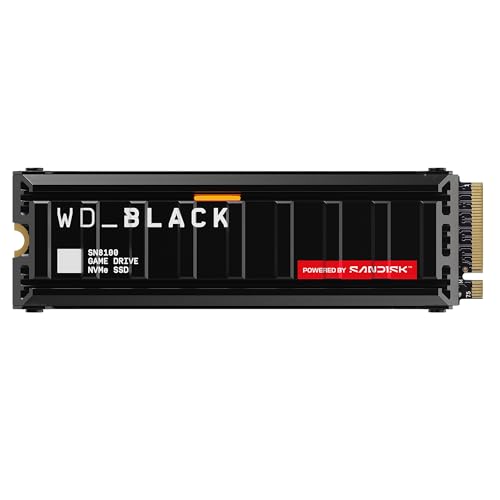
Bare drive version requires substantial integrated motherboard heatsink with functional case airflow. Installing bare drive without aluminum shield leads to rapid thermal throttling down to PCIe 3.0/4.0 speed brackets within seconds of heavy writes. Heatsink models use low-profile design compatible with desktop graphics card clearance, integrated with customizable RGB lighting controlled via Sandisk Dashboard utility.
[acms_product asin=”B0F3GGX4SK”]WD_Black SN8100 1TB NVMe SSD with Heatsink
1TB heatsink variant serves as high-speed entry point to PCIe 5.0 ecosystem. Drive targets dedicated operating system installs hosting complex application workflows, simulation binaries, and scratch files.
- Target Role: Desktop OS drive, primary gaming storage, high-speed project staging.
- Sequential Performance: Up to 14,900 MB/s read, 11,000 MB/s write.
- Thermal Solution: Factory-installed low-profile anodized aluminum heatsink with RGB.
- Constraints: 1TB write buffer fills faster during continuous uncompressed video dump than larger multi-channel models.
Integrated heatsink solves thermal saturation without occupying vertical slot height needed by CPU air coolers or adjacent GPU backplates. Access WD_Black SN8100 1TB NVMe SSD with Heatsink to verify live price and retail availability.
[acms_product asin=”B0F3H14JQG”]WD_Black SN8100 2TB NVMe SSD with Heatsink
2TB heatsink unit expands internal parallel channel paths across CBA NAND dies. Channel expansion increases sequential write speed from 11,000 MB/s to 14,000 MB/s, with random IOPS pushing past 2,300,000 operations. Model suits demanding creative media workstations evaluated in our guide to top SSDs for content creators.
- Target Role: Professional workstation storage, AI local model weight deployment, 8K RAW video cache.
- Sequential Performance: Up to 14,900 MB/s read, 14,000 MB/s write.
- Durability Threshold: 1,200 TBW rating handles routine large-scale write cycles.
- Cooling Package: Pre-attached factory heatsink ensures passive cooling along chassis front-to-back air path.
Increased queue depth handling makes 2TB edition technically superior for simultaneous read/write operations like compiling multi-gigabyte source trees while rendering video proxies. Review current details for WD_Black SN8100 2TB NVMe SSD with Heatsink via product card.
[acms_product asin=”B0F3BMBQ75″]WD_Black SN8100 1TB NVMe SSD (Bare Drive)
Bare M.2 2280 variant drops factory aluminum block. Unit targets custom desktop builds equipped with thick, dedicated motherboard M.2 heat spreaders or third-party liquid-cooling blocks.
- Target Role: Custom PC builds using motherboard armor heatsinks or high-mass passive blocks.
- Sequential Performance: Up to 14,900 MB/s read, 11,000 MB/s write.
- Clearance Benefit: Zero interference with bulky graphics cards or specialized M.2 retention brackets.
- Critical Requirement: Unusable in bare state under high load; user must apply thermal pads and metal sink prior to operation.
Bare drive form factor fits standard desktop slots easily, but thermal footprint prohibits compact notebook usage. Users seeking mobile upgrades should reference our best NVMe SSD for laptop guide instead. Inspect specifications on WD_Black SN8100 1TB NVMe SSD – PCIe 5.0×4 to verify live price.
Platform Compatibility and Diagnostics
PCIe 5.0 requires capable CPU socket and motherboard chipset routing. Diagnostic table below assists matching SN8100 drive to platform constraints.
| Hardware Platform | M.2 Slot Support | Operational Behavior | Recommended Action |
|---|---|---|---|
| Intel Z790 / B760 (Gen5 Slot) | PCIe 5.0×4 routed from CPU | Full 14,900 MB/s speed; may bifurcate primary GPU slot to x8 lanes. | Check motherboard manual for GPU lane division rules. |
| AMD X670E / B650E / X870 | PCIe 5.0×4 dedicated CPU lanes | Full rated speed; GPU maintains full x16 lane allocation. | Ideal deployment. Install in top M.2_1 slot directly above GPU. |
| Intel Z690 / AMD B550 / X570 | PCIe 4.0×4 maximum | Drive throttles down to Gen4 interface ceiling (~7,400 MB/s). | Overkill expenditure unless planning motherboard upgrade soon. |
| Standard Laptops | M.2 2280 PCIe 4.0/3.0 | Thermal accumulation leads to severe throttling or failure. | Do not install. Use Gen4 drives with under-5W operational power. |
Installation and Verification Checklist
Follow technical sequence below to confirm full performance without firmware or thermal bottlenecks.
- Verify Lane Allocation: Mount drive in primary M.2 slot linked directly to CPU, not secondary chipset slot limited to PCIe 4.0.
- Check Thermal Interface Material: If using bare model, peel plastic protective film from motherboard thermal pads before securing drive.
- Verify BIOS Link Speed: Enter UEFI. Confirm M.2 slot operating mode set to Gen 5 / Auto. Avoid Gen 3 / Gen 4 forced manual overrides.
- Download Sandisk Dashboard: Install official Windows software package. Verify drive health, initialize partition format, and flash current firmware.
- Inspect Thermal Baseline: Monitor idle temperatures using dashboard software. Baseline idle temperature should rest below 50°C in airflow chassis.
Frequently Asked Questions
Can WD_Black SN8100 run on PCIe 4.0 motherboards?
Yes. PCIe interface backward-compatible. Drive operates normally on PCIe 4.0 or PCIe 3.0 slots, but maximum transfer speeds cap near 7,400 MB/s and 3,500 MB/s respectively. Drive functions reliably, but extra Gen5 bandwidth potential remains unused.
Does WD_Black SN8100 heatsink fit inside PlayStation 5?
Physical height fits PS5 M.2 bay dimensions, but PS5 internal controller interface caps at PCIe 4.0 bandwidth (roughly 5,500 MB/s minimum recommended, ~6,500 MB/s practical ceiling). Drive functions inside console, but Gen5 speeds offer zero practical advantage over standard Gen4 SSDs in PS5 system architecture.
Why does 2TB model write faster than 1TB model?
2TB configuration populates more NAND dies across controller channels. Parallel write operations allow controller to interleave writes across higher die count simultaneously, raising continuous write limits from 11,000 MB/s up to 14,000 MB/s.
Pros
- Very high claimed PCIe 5.0 read performance
- Integrated heatsink helps maintain sustained performance
- Compact M.2 2280 form factor
- RGB lighting and low-profile aluminum construction
- Useful monitoring and migration software included
Cons
- Requires a compatible PCIe 5.0 motherboard and system to reach its rated performance
- PCIe 5.0 speeds can produce more heat and may offer limited real-world gains for everyday users
- Windows is required for the full SANDISK Dashboard software experience
| Color | Black |
|---|---|
| Size | 1TB |
| Dimensions | 3.149606296 x 0.9842519675 x 0.44094488144 inches |
| Weight | 0.068784225744 pounds |
| Product Group | Personal Computer |
| Binding | Personal Computers |
Best suited to shoppers comparing internal solid state drives products who specifically need pCIe 5.0 x4 performance helps reduce load times and accelerate demanding workflows., Claimed sequential read speeds up to 14,900MB/s support rapid game launches and….
Before buying, compare the exact model’s compatibility, dimensions, core specifications, warranty, recurring owner feedback, and current price against other internal solid state drives options. Retailer availability and pricing can change after publication.
Pros
- Extremely fast PCIe 5.0 performance for demanding workloads
- Integrated heatsink supports longer sustained performance under heavy use
- Large 2TB capacity for games, applications, and creative files
- Low-profile design with customizable RGB lighting
- Strong endurance potential from TLC NAND technology
Cons
- Requires a compatible PCIe 5.0 x4 platform to reach its rated performance
- High-end speed may provide limited everyday benefit for basic office or browsing tasks
- The integrated heatsink can be less convenient for systems that already use a motherboard M.2 heatsink
| Color | Black |
|---|---|
| Size | 2TB |
| Dimensions | 3.149606296 x 0.9842519675 x 0.44094488144 inches |
| Weight | 0.068784225744 pounds |
| Product Group | Personal Computer |
| Binding | Personal Computers |
Best suited to shoppers comparing internal solid state drives products who specifically need accelerates game loads, large file transfers, and creative workflows with sequential read speeds up to 14,900MB/s., Handles demanding multitasking and professional applications with sequential….
Before buying, compare the exact model’s compatibility, dimensions, core specifications, warranty, recurring owner feedback, and current price against other internal solid state drives options. Retailer availability and pricing can change after publication.

Pros
- Exceptional sequential and random performance for demanding applications
- Strong power efficiency reduces heat and system load
- High endurance ratings support professional workloads
- Broad capacity range including 8TB options
- Useful software tools for migration and monitoring
Cons
- PCIe 5.0 performance requires a compatible motherboard and CPU
- High sustained speeds may still need adequate case airflow in compact builds
- 1TB model offers less headroom for massive media libraries than higher capacities
| Digital Storage Capacity | 1 TB |
|---|---|
| Hard Disk Interface | PCIE x 4 |
| Connectivity Technology | NVMe, PCIe Gen5 |
| Additional Features | ADVANCED RELIABILITY., BREAKNECK SPEEDS, EXPERIENCE PCIe Gen 5 |
| Hard Disk Form Factor | 22 Millimeters |
| Compatible Devices | Desktop, Laptop |
| Specific Uses For Product | Gaming, Multimedia, Personal |
| Read Speed | 14900 Megabytes Per Second |
| Media Speed | 11000 |
| Data Transfer Rate | 14900 Megabytes Per Second |
Best suited to shoppers comparing internal solid state drives products who specifically need achieve faster game loads and quicker AI model training with sequential reads up to 14,900 MB/s, Maintain system stability during long sessions thanks to….
Before buying, compare the exact model’s compatibility, dimensions, core specifications, warranty, recurring owner feedback, and current price against other internal solid state drives options. Retailer availability and pricing can change after publication.
Add PCGearWiki as a preferred source on Google
Sources and Verification
Research basis: Product identity, dimensions, interfaces, supported features, and warranty terms are checked against available manufacturer documentation and current retailer listings. Price, stock, and aggregate customer ratings can change after publication.
Primary references for this guide: NVM Express specifications.
Testing disclosure: Unless this article explicitly states that PCGearWiki performed hands-on testing and describes the test setup, recommendations are research-based editorial evaluations rather than PCGearWiki laboratory measurements. Customer feedback is used to identify recurring ownership patterns, not as proof of technical performance.
Last source review: October 13, 2026. See our Review Methodology, Editorial Policy, and Corrections Policy.


Write Your Review
No reviews yet. Be the first to share your experience!