

Last updated: October 2, 2026
External drive for video editing demand continuous write performance, not peak marketing bursts. Drive must sustain continuous stream without dropping frames during live 4K recording or proxy rendering. Interface choice between USB 3.2 Gen 2, Gen 2×2, or Thunderbolt dictates actual timeline scrubbing responsiveness.
Specification assessment below evaluates manufacturer throughput ratings, bus limits, thermal profiles. Check live pricing via linked product cards; figures fluctuate rapidly based on flash supply. For general storage context, see comprehensive external SSD buying guide.
External SSD Editing Comparison
| Drive Model | Interface Spec | Claimed Read | Claimed Write | Primary Editing Target |
|---|---|---|---|---|
| Samsung T7 1TB | USB 3.2 Gen 2 (10Gbps) | 1050 MB/s | 1000 MB/s | 4K ProRes mobile recording, 1080p multi-cam |
| SanDisk Extreme 1TB (New Model) | USB Type-C (Gen 2×2 class) | 2000 MB/s | 2000 MB/s | High-bitrate intraframe, fast proxy offload |
| SanDisk Extreme 2TB (Old Model) | USB 3.2 Gen 2 (10Gbps) | 1050 MB/s | 1000 MB/s | Large project scratch disk, bulk RAW storage |
Editing Codec and Hardware Diagnostic Matrix
Select drive configuration based on capture codec, timeline layer count, host OS bus architecture. Bottlenecks occur when protocol negotiation drops below bitrate ceiling.
| Workflow Type | Data Throughput Needed | Bus Requirement | Recommended Drive Class |
|---|---|---|---|
| Single Stream 4K60 ProRes 422 HQ | ~220 MB/s (1760 Mbps) | USB 3.2 Gen 2 (10Gbps) | 1050 MB/s class NVMe drive |
| Multicam 4K 10-bit H.265 / All-I | 400–600 MB/s concurrent | USB 3.2 Gen 2 minimum | 1050 MB/s+ with high thermal mass |
| Direct Camera Capture (iPhone 15/16 Pro) | ~220 MB/s write target | USB Type-C 10Gbps (Host limited) | Low-power 1050 MB/s rated unit |
| Uncompressed 4K / 8K RAW Offload | 1500+ MB/s ingest | USB 3.2 Gen 2×2 or TB3/TB4 | 2000 MB/s rated Gen 2×2 bridge |
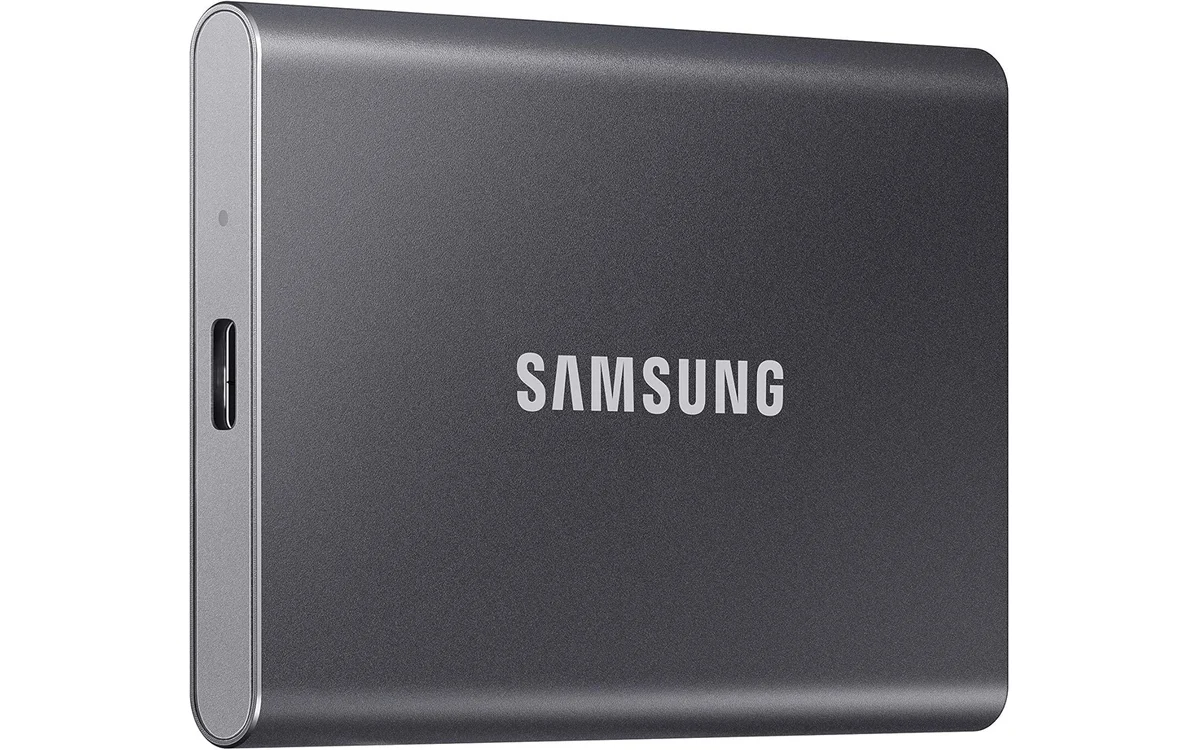
Samsung T7 Portable SSD, 1TB External Solid State
Samsung T7 uses internal PCIe NVMe bridge paired with USB 3.2 Gen 2 interface. Delivers theoretical maximum throughput up to 1050 MB/s read, 1000 MB/s write. Aluminum unibody serves as passive heatsink, critical for avoiding early thermal throttling during long video exports.
Drive features broad host compatibility across macOS, Windows, iPadOS, direct camera recording systems. Officially supports direct external ProRes 4K 60fps recording from iPhone 15 Pro hardware. Limitation rests in single-lane Gen 2 protocol cap: cannot exceed roughly 950–1000 MB/s real-world data flow regardless of host host port capability. Aluminum body warms significantly under continuous render passes. Good balance for lightweight field production kits, mobile editing bays, scratch disk work.
[acms_product asin=”B0GMWYYRQL”]SANDISK 1TB Extreme Portable SSD (New Model)
New model SanDisk Extreme boosts ceiling to 2000 MB/s interface read and write limits. Utilizes 20Gbps signaling standard. Target market: editors ingesting high-volume RAW camera cards, moving multi-gigabyte project archives rapidly between workstations.
Shell provides IP65 water, dust resistance, 3-meter drop survival rating, integrated loop for field kit rigging. Critical architectural constraint: 2000 MB/s requires host support for USB 3.2 Gen 2×2. Apple silicon Macs do not support Gen 2×2 protocol; connection drops to standard 10Gbps (~1000 MB/s ceiling). Windows desktops with explicit Gen 2×2 motherboard controllers extract full bandwidth. Validate host controller specs before buying for speed premium.
[acms_product asin=”B08HN37XC1″]SANDISK 2TB Extreme Portable SSD (Old Model)
Legacy SDSSDE61 revision runs on standard USB 3.2 Gen 2 10Gbps controller. Claims 1050 MB/s read, 1000 MB/s write speeds. 2TB capacity point provides required volume for complex NLE project directories containing multi-camera angles, high-frame-rate scratch media, render caches.
Drive includes ruggedized casing with IP65 ingress protection, 256-bit AES hardware encryption. Firmware updates addressed earlier operational anomalies reported in field. Operates at full speed on both macOS and Windows standard USB-C ports without protocol mismatch. Good choice for primary editing scratch workspace where capacity per dollar matters more than niche 20Gbps host connectivity. For sustained internal storage comparisons, reference sustained write NVMe evaluation.
Technical Constraints for NLE Workloads
Video editing places unique stress on solid-state hardware. Sequential burst figures displayed on retail packaging do not guarantee timeline stability.
SLC Cache Exhaustion vs Sustained State
Portable NVMe drives use pseudo-SLC cache zones to accelerate initial writes. File transfers begin at interface wire-speed. Once SLC buffer fills (often 20GB to 100GB depending on controller allocation), write operations drop directly to native TLC or QLC NAND speeds. Cheap drives plunge below 150 MB/s in native state, dropping timeline frames during render output. Quality editing drives maintain higher direct-to-die write floors.
Host Controller Bottlenecks: USB 3.2 vs Thunderbolt
USB protocol naming creates severe compatibility traps:
- USB 3.2 Gen 2: 10 Gbps (approx 1050 MB/s theoretical, ~950 MB/s actual). Universal across modern Macs, PCs, iPads, cameras.
- USB 3.2 Gen 2×2: 20 Gbps (dual lane). Rare on laptops, absent on Apple silicon hardware. Falling back to 10Gbps lane causes drive to deliver half rated 2000 MB/s speed on Mac systems.
- USB4 / Thunderbolt: PCIe tunneling standard. External SSD must explicitly house Thunderbolt/USB4 controller to exceed 1050 MB/s on Apple machines.
Thermal Dissipation Failures
Video rendering runs NAND flash and bridge controllers at maximum duty cycle for extended periods. Drives lacking internal thermal interface pads or metal exterior bodies heat rapidly. Upon reaching thermal threshold (~70°C internal controller sensor), drive enters aggressive thermal throttling, slashing transfer rates by 50% or dropping offline entirely. If experiencing device disconnects during heavy timeline renders, consult external drive disconnect troubleshooting.
Filesystem Overhead
Default format impacts stability across operating environments. Avoid exFAT for primary scratch drives if editing strictly on single operating system. exFAT lacks journaling; sudden disconnection corrupts project index files. Use APFS for pure macOS environments, NTFS for Windows. Utilize exFAT only when cross-platform delivery between field shooter and post-production studio strictly requires portability.
Pre-Flight Timeline Verification Checklist
- Port Verification: Ensure cable plugs into direct motherboard root hub port, not unpowered passive USB desk hub.
- Filesystem Audit: Format drive using native OS filesystem (APFS or NTFS) with 128K+ allocation units for large video block handling.
- Thermal Clearance: Place SSD on flat metal or conductive surface; do not operate inside camera pouches or under equipment cases during long renders.
- Sleep Settings Override: Disable OS disk sleep timer in energy settings to stop premature port suspension during background proxy generation.
- Bandwidth Negotiation Check: Verify link speed in System Information (macOS) or Device Manager/USB Tree Viewer (Windows) confirms 10Gbps or 20Gbps operation.
Frequently Asked Questions
Can you edit 4K video directly off external SSD?
Yes. USB 3.2 Gen 2 drive delivering 900+ MB/s real-world read speed easily handles multiple streams of compressed 4K footage (ProRes, H.264, H.265). Ensure project scratch disks, cache files point to external volume to relieve host boot drive space.
Why does 2000 MB/s SSD only show 1050 MB/s on Mac?
Apple Mac hardware lacks USB 3.2 Gen 2×2 (20Gbps dual-lane) controllers. Port defaults to single-lane USB 3.2 Gen 2 mode, limiting bandwidth to theoretical 10Gbps ceiling. Exceeding 1050 MB/s on Apple hardware requires certified USB4 or Thunderbolt external drive.
Is 1TB capacity enough for video editing scratch disk?
1TB provides sufficient room for single active 4K project containing 200–400GB raw footage plus generated proxies and render cache files. For multi-camera documentary work or uncompressed RAW workflows, 2TB or larger capacity prevents drive from reaching >85% fill rate where write speeds degrade.

Pros
- Fast transfer rates for efficient workflows
- Durable aluminum build for everyday mobility
- Broad device compatibility without extra adapters
- Compact size with high capacity options
Cons
- No dust or water resistance rating
- Maximum speeds require compatible USB 3.2 Gen 2 hosts
- May need reformatting on certain operating systems
| Digital Storage Capacity | 1 TB |
|---|---|
| Hard Disk Interface | USB 3.0 |
| Connectivity Technology | USB |
| Additional Features | 256-Bit AES Hardware Encryption, Read Speeds up to 1050 MB/s, Shock Resistant, Thermal Control, Write Speeds up to 1000 MB/s |
| Compatible Devices | Gaming Console, Mac, PC, Smartphone, Tablet |
| Specific Uses For Product | business, gaming |
| Read Speed | 1050 Megabytes Per Second |
| Media Speed | 1000 megabits_per_second |
| Cache Memory Installed Size | 1 |
| Data Transfer Rate | 10 Gigabits Per Second |
Best suited to shoppers comparing external solid state drives products who specifically need move large files rapidly with up to 1050 MB/s speeds to save time on transfers, Store extensive data in capacities up to 4TB within….
Before buying, compare the exact model’s compatibility, dimensions, core specifications, warranty, recurring owner feedback, and current price against other external solid state drives options. Retailer availability and pricing can change after publication.

Pros
- Fast transfer speeds support efficient content handling
- Rugged IP65 rating and drop protection enhance reliability outdoors
- Compact size improves portability for travel and daily use
- Encryption adds security layer for sensitive projects
- Modern USB-C connectivity ensures broad device compatibility
Cons
- Full speeds require a compatible USB-C host device
- Encryption requires initial setup before use
- May need adapters for older USB-A ports
| Digital Storage Capacity | 1 TB |
|---|---|
| Hard Disk Interface | USB 3.0 |
| Connectivity Technology | USB |
| Brand | Sandisk |
| Special Feature | Dust Resistant, Password Protection, Portable, Shock Resistant, Water Resistant |
| Hard Disk Form Factor | 0.4 Inches |
| Hard Disk Description | Solid State Drive |
| Compatible Devices | Desktop, Laptop, Smartphone, Tablet |
| Installation Type | External Hard Drive |
| Color | Black |
Best suited to shoppers comparing external solid state drives products who specifically need move large media files quickly with up to 2000MB/s speeds to streamline workflows, Safeguard data against spills, dust, and drops from up to 3….
Before buying, compare the exact model’s compatibility, dimensions, core specifications, warranty, recurring owner feedback, and current price against other external solid state drives options. Retailer availability and pricing can change after publication.

Pros
- Fast NVMe speeds support efficient large file handling
- Rugged IP65 rating and drop protection enhance reliability outdoors
- Hardware encryption adds strong data security layer
- Carabiner loop improves portability and attachment options
Cons
- Older model may not match performance of current Extreme PRO versions
- Maximum speeds require compatible host devices and interfaces
- App features need separate download and are platform limited
| Digital Storage Capacity | 2 TB |
|---|---|
| Hard Disk Interface | eSATA |
| Connectivity Technology | USB |
| Additional Features | Dust Resistant, Water Resistant, Portable, Hardware Encryption |
| Hard Disk Form Factor | 2.5 Inches |
| Compatible Devices | Desktop, Laptop, Tablet |
| Hard Disk Rotational Speed | 500 RPM |
| Specific Uses For Product | personal, gaming, business |
| Read Speed | 1050 Megabytes Per Second |
| Media Speed | 1000 |
Best suited to shoppers comparing external solid state drives products who specifically need transfer large files quickly with up to 1050MB/s read speeds to speed up content creation workflows, Rely on IP65 water and dust resistance plus….
Before buying, compare the exact model’s compatibility, dimensions, core specifications, warranty, recurring owner feedback, and current price against other external solid state drives options. Retailer availability and pricing can change after publication.
Sources and Verification
Research basis: Product identity, dimensions, interfaces, supported features, and warranty terms are checked against available manufacturer documentation and current retailer listings. Price, stock, and aggregate customer ratings can change after publication.
Testing disclosure: Unless this article explicitly states that PCGearWiki performed hands-on testing and describes the test setup, recommendations are research-based editorial evaluations rather than PCGearWiki laboratory measurements. Customer feedback is used to identify recurring ownership patterns, not as proof of technical performance.
Last source review: October 2, 2026. See our Review Methodology, Editorial Policy, and Corrections Policy.


Write Your Review
No reviews yet. Be the first to share your experience!