

Last updated: October 7, 2026
The best silent mechanical keyboard under $100 depends on whether you prioritize wireless flexibility, customization, a compact 96% layout, or a straightforward wired office design. Based on the supplied product data, the SOLAKAKA KI99 Pro is the most versatile pick, while the CHERRY KC 200 MX is better for buyers who prefer a simple wired keyboard with established MX2A Silent Red switches.

This roundup sits within the Best Gaming Keyboards category and focuses on keyboards listed below the $100 budget. The available products include three tri-mode wireless 96% models and one wired full-size office keyboard. Because no hands-on measurements, noise recordings, latency tests, or review text were supplied, the recommendations below separate manufacturer specifications from PCGearWiki editorial judgment.

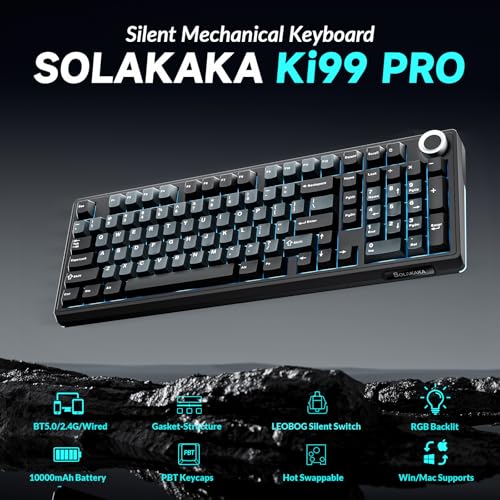
SOLAKAKA KI99 Pro Wireless Mechanical Keyboard


As an Amazon Associate we earn from qualifying purchases. Product prices and availability are accurate as of the date/time indicated.
Quick Verdict
The SOLAKAKA KI99 Pro Wireless Mechanical Keyboard is the strongest all-round recommendation for most buyers who want quiet typing, wireless connectivity, hot-swappable switches, RGB lighting, and a compact 96% layout. Its main limitation is that the supplied data does not include independent noise or wireless-latency measurements. Choose CHERRY instead if wired reliability matters more than customization.
The AULA F99 Pro is the better fit for users who want multi-device switching, a control knob, macro support, and an 8,000mAh battery. The less expensive AULA F99 Silent offers a similar feature set with a lower listed price, but its supplied rating is lower than the Pro version. The CHERRY KC 200 MX is the least flexible option, yet its wired design and MX2A Silent Red switches make it the clearest office-focused alternative.
Key Specifications
| Specification | Details | Why it matters |
|---|---|---|
| Layout | SOLAKAKA KI99 Pro, AULA F99 Pro, and AULA F99 use a 96% layout; CHERRY KC 200 MX is a full-size wired office keyboard according to the supplied product descriptions. | A 96% layout saves desk space while retaining arrow keys and a number area; full-size designs are familiar for office work and data entry. |
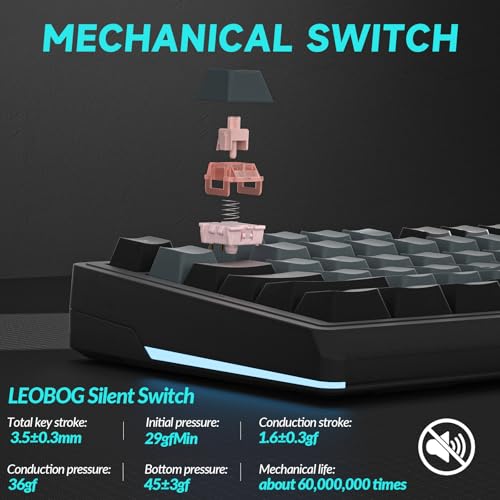
| Switch type | SOLAKAKA uses LEOBOG silent switches; both AULA models use pre-lubed quiet linear switches; CHERRY uses CHERRY MX2A Silent Red linear switches. | Linear switches avoid a click mechanism, while the specific sound and feel still depend on the switch, case, keycaps, desk, and typing force. |
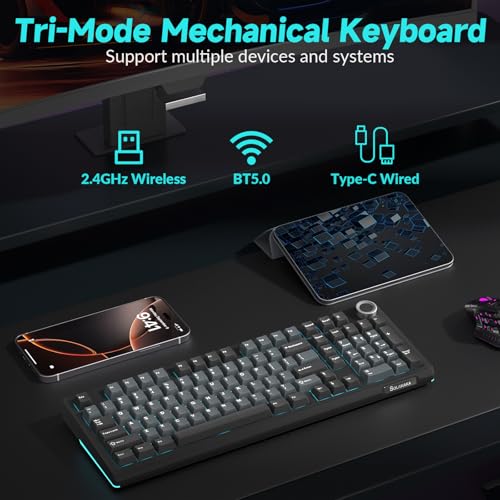
| Wireless connectivity | SOLAKAKA and both AULA models support Bluetooth 5.0, 2.4GHz wireless, and USB Type-C wired connection. | Tri-mode keyboards can serve a desktop, laptop, tablet, or mobile device, but wireless compatibility and software support should be checked separately. |
| Battery specification | SOLAKAKA lists a 10,000mAh battery; both AULA models list an 8,000mAh battery. | Higher stated capacity may reduce charging frequency, but the supplied data does not provide runtime testing. |
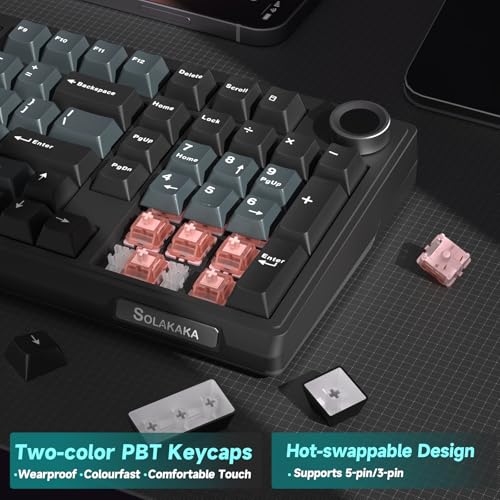
| Customization | SOLAKAKA and both AULA models support hot-swappable 3-pin and 5-pin switches. Software and macro support are listed for all three wireless models. | Hot-swap support allows switch changes without soldering, subject to physical and electrical compatibility. |
| Keycaps | SOLAKAKA uses PBT keycaps; AULA F99 Pro uses side-printed PBT keycaps; AULA F99 uses double-shot PBT keycaps; CHERRY uses molded, laser-etched keycaps. | Keycap construction affects legend durability, lighting behavior, texture, and replacement options. |
| Lighting | SOLAKAKA lists full-key RGB and side light bars. Both AULA models list RGB lighting with 16 effects and software controls. CHERRY lists white status LEDs. | RGB is useful for desk appearance and key visibility, while the CHERRY design is more restrained and office-oriented. |
| Gaming features | AULA lists N-key rollover and macro customization. SOLAKAKA lists programmable keys and macros. CHERRY lists full N-key rollover and anti-ghosting. | These features help with simultaneous key presses and shortcuts, but they do not prove a particular latency level. |

Design and Build Quality
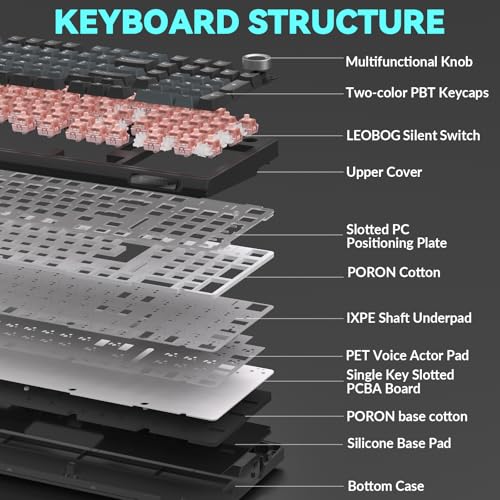
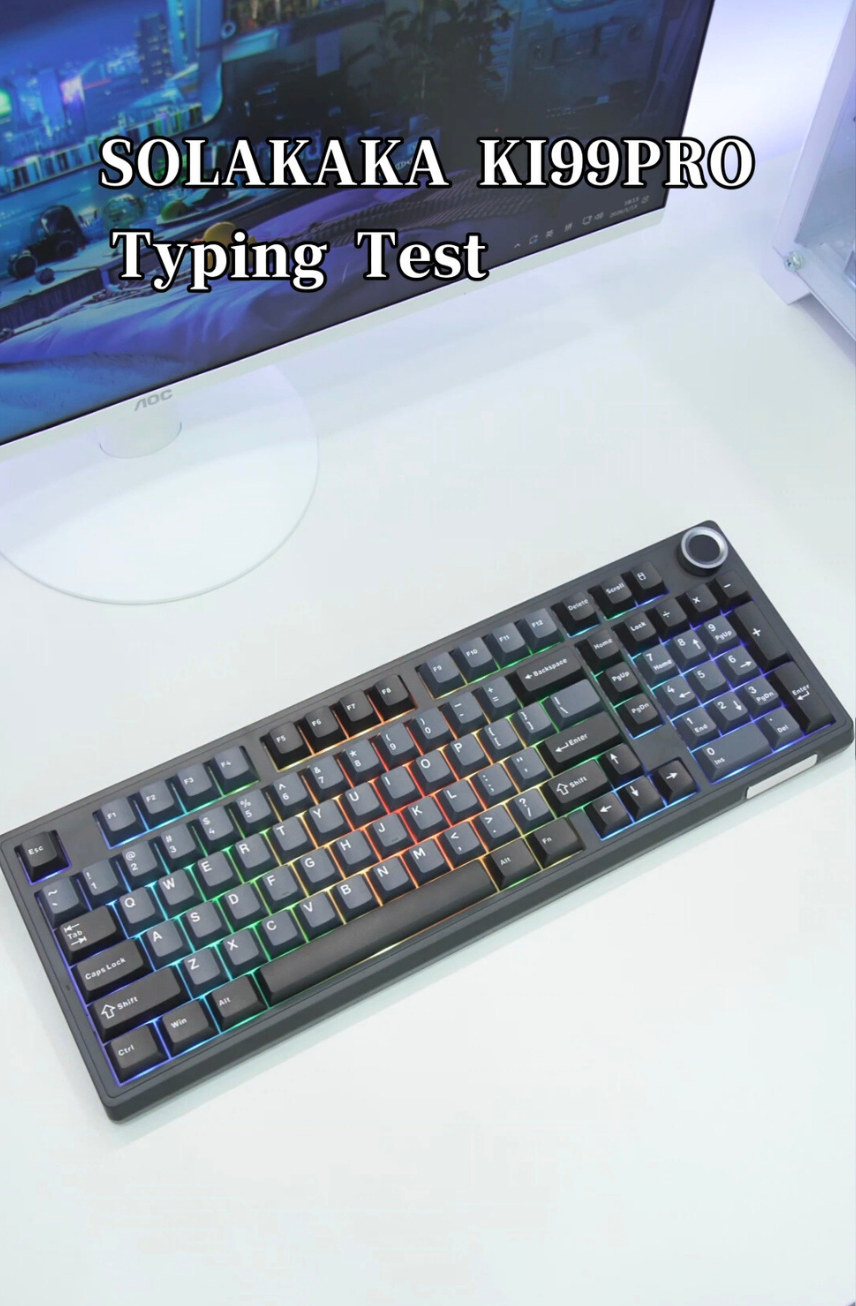
The SOLAKAKA KI99 Pro uses a compact 96% layout with a control knob. According to the manufacturer information supplied, its gasket structure combines five noise-reducing layers with silent switches. The keyboard also uses PBT keycaps and a 1.2mm flex-cut printed circuit board (PCB). This combination is aimed at a softer, more cushioned typing experience while preserving the navigation and number keys many users lose on smaller layouts.
The KI99 Pro’s knob can adjust volume, media functions, or lighting brightness. That flexibility is useful because it puts common controls within reach without requiring a function-layer shortcut. Its trade-off is that the supplied information does not identify the exact case material, dimensions, weight, or included accessories, so buyers should not infer a premium chassis from the gasket terminology alone.
The AULA F99 Pro follows a similar 96% format and adds a multifunction knob that can operate in lighting or multimedia mode. Its gasket structure includes an integrated silicone pad, PCB single-key slotting, and five layers of filling intended to counteract cavity noise. Side-printed PBT keycaps are designed to improve backlight visibility while providing a sweat-resistant surface, according to the product information.
The AULA F99 uses the same broad design formula but specifies double-shot PBT keycaps rather than the F99 Pro’s side-printed arrangement. Double-shot construction can be attractive to buyers who care about durable legends, while the F99 Pro may appeal more to users who want brighter side-lit keycap presentation. The available data does not establish that either construction is universally quieter.
The CHERRY KC 200 MX takes a different approach. It is a wired mechanical office keyboard with an anodized metal plate, molded keycaps, laser-etched abrasion-resistant legends, non-slip fold-out feet, and white status LEDs. Its full-size office design should suit users who want a familiar layout and dedicated calculator and volume controls rather than wireless operation, RGB effects, or switch experimentation.
Performance and Real-World Use
Silent mechanical keyboards reduce switch and case noise, but “silent” does not mean completely inaudible. Keycap impact, bottoming out, stabilizer movement, desk resonance, and typing force still affect the sound. The SOLAKAKA and AULA descriptions specifically combine quiet or silent switches with internal dampening, which is a more complete approach than relying on the switch name alone. No measured decibel results were supplied.
For typing, the SOLAKAKA KI99 Pro is the most adaptable option in this group. Its silent switches, gasket construction, PBT keycaps, and flex-cut PCB target a smoother feel, while hot-swap support gives users an upgrade path if they later prefer a different linear or tactile switch. The editorial limitation is that “smooth” and “creamy” are manufacturer-style descriptions rather than independently measured feel characteristics.
The AULA F99 Pro is particularly practical for a mixed work-and-gaming desk. It can connect through Bluetooth 5.0, 2.4GHz wireless, or USB-C, and the listing says it can connect with up to five devices. The knob, macro support, RGB controls, and N-key rollover give it more desk-management features than the CHERRY model. However, the supplied data does not provide wireless latency, polling behavior, or battery-runtime measurements.
The AULA F99 offers much of the same functional concept at a lower listed price. Its tri-mode connectivity, five-device switching, quiet pre-lubed linear switches, gasket structure, RGB lighting, and hot-swap PCB make it a strong value-oriented alternative. Compared with the Pro version, the supplied information identifies an 8,000mAh battery on both models but does not explain every internal or firmware difference, so buyers should confirm the exact listing before ordering.
The CHERRY KC 200 MX is the most straightforward keyboard for office use. Its MX2A Silent Red switches are specified as smooth, quiet, and linear, with more than 50 million actuations per key stated by CHERRY. Full N-key rollover and anti-ghosting support simultaneous key recognition. These specifications make it suitable for general gaming and productivity, but the wired-only design and lack of listed hot-swap support make it less appealing to customization-focused enthusiasts.
For gaming, all three wireless models provide features associated with gaming keyboards, including RGB lighting, macros, and compact layouts. AULA explicitly lists N-key rollover, while CHERRY explicitly lists full N-key rollover and anti-ghosting. None of the supplied records includes a measured latency result, response-time test, polling-rate figure, or competitive gaming benchmark. Buyers seeking specialized adjustable actuation or rapid-trigger behavior should compare dedicated gaming models instead, such as those covered in the guide to gaming keyboards with adjustable actuation.
Compatibility
The SOLAKAKA KI99 Pro supports Windows, macOS, PCs, laptops, and smartphones through Bluetooth 5.0, 2.4GHz wireless, or USB Type-C, according to the supplied manufacturer information. The AULA F99 Pro and AULA F99 also list Windows or Mac compatibility and support connection to PCs, laptops, tablets, gaming consoles, and mobile phones. USB-C confirms the connector type, not guaranteed operating-system software support.
Before buying a wireless model, check whether the package includes the required 2.4GHz receiver and whether your target device accepts the relevant wireless mode. Bluetooth may be convenient for tablets and phones, while 2.4GHz is typically the intended desktop-gaming connection. Because no detailed software compatibility matrix was supplied, confirm whether the configuration driver supports your operating system before relying on macros or RGB customization.
The 96% layout preserves more keys than a tenkeyless design but still occupies less desk space than a conventional full-size keyboard. It is a good compromise for users who need arrow keys and a number area. The CHERRY KC 200 MX is the safer layout choice for users who frequently use a traditional navigation cluster or want a familiar office arrangement without adapting to compact key spacing.
Hot-swap compatibility also has limits. The SOLAKAKA and AULA records state support for 3-pin and 5-pin switches, but that does not mean every switch, keycap profile, stabilizer, or plate will fit perfectly. Buyers planning modifications should verify switch orientation, socket type, keycap compatibility, and the keyboard’s layout-specific key sizes before purchasing replacement parts.
Pros and Cons
The following strengths and drawbacks are based on the supplied specifications and editorial comparison. They are not the result of PCGearWiki laboratory testing.
- Tri-mode wireless and wired connectivity is available on the SOLAKAKA and both AULA keyboards.
- The SOLAKAKA KI99 Pro lists a 10,000mAh battery, while the AULA models list 8,000mAh batteries.
- All three wireless keyboards support hot-swappable 3-pin and 5-pin switches.
- Gasket structures and internal dampening are specified for the wireless silent models.
- The CHERRY KC 200 MX uses CHERRY MX2A Silent Red switches and includes full N-key rollover and anti-ghosting.
- Each recommendation has a distinct role, from customizable wireless gaming to quiet wired office work.
- No independent sound-level, latency, polling, or battery-runtime measurements were supplied.
- The 96% models may require adjustment for buyers accustomed to a full-size keyboard.
- The wireless keyboards depend on software for some macro and lighting functions.
- The CHERRY KC 200 MX lacks the wireless and hot-swap flexibility highlighted for the other recommendations.
- Product listings do not provide enough detail to confirm every included accessory, dimension, or software limitation.
Who Should Buy It?
Choose the SOLAKAKA KI99 Pro Wireless Mechanical Keyboard if you want the broadest combination of quiet typing, wireless flexibility, customization, and battery capacity. It is especially suitable for a shared office, bedroom gaming setup, or workstation that moves between a desktop and laptop. The control knob and 96% layout also suit users who want quick media controls without giving up a number area.
Choose the AULA F99 Pro if switching among several devices is central to your workflow. Its stated support for up to five connected devices, multifunction knob, RGB controls, macros, and hot-swap PCB make it the most feature-dense choice in the supplied lineup. It is a better fit than the SOLAKAKA when device switching is more important than the larger stated battery capacity.
Choose the AULA F99 if you want the same general silent 96% wireless concept at a lower listed price than the Pro variant. It is appropriate for buyers who want pre-lubed quiet linear switches, RGB lighting, PBT keycaps, and solder-free switch replacement without paying for the Pro model’s higher listed position.
Choose the CHERRY KC 200 MX if you prefer a dependable wired office setup, a full-size layout, and a known CHERRY switch family over wireless convenience or enthusiast customization. It is also the clearest choice for buyers who do not want to manage battery charging, wireless receivers, or configuration software.
Who Should Skip It?
Skip the SOLAKAKA and AULA models if your priority is independently verified wireless latency, battery runtime, or measured acoustic performance. The supplied records contain manufacturer specifications but no third-party testing. For competitive gaming, look for a keyboard with documented latency and polling behavior rather than assuming that tri-mode connectivity guarantees a particular response level.
Skip all three 96% keyboards if you need a completely traditional full-size layout or rely heavily on a familiar office key arrangement. Although these keyboards retain a number area, compact layouts can place keys differently from a standard full-size design. The CHERRY model is a better starting point for users who want conventional office ergonomics.
Skip the CHERRY KC 200 MX if you specifically need Bluetooth, 2.4GHz wireless, RGB customization, or solder-free switch replacement. Its strengths are simplicity, wired operation, and the stated MX2A Silent Red specification—not flexibility for keyboard modding.
Alternatives to Consider
The supplied products overlap in layout and quiet-switch design, but they are not interchangeable recommendations. The best wireless mechanical keyboard under $100 guide is a useful next step if wireless connectivity is your main requirement. Within this shortlist, the AULA F99 Pro is the strongest multi-device alternative to the SOLAKAKA, while the AULA F99 is the lower-cost alternative.
AULA F99 Pro Wireless Mechanical Keyboard-Silent: choose it instead of the SOLAKAKA when connecting up to five devices and using a multifunction knob are more important than the larger stated battery capacity. Its limitation is the higher listed price and the absence of supplied independent measurements.
AULA F99 Wireless Mechanical Keyboard-Silent: choose it when you want tri-mode connectivity, a gasket-mounted structure, RGB lighting, hot-swap support, and double-shot PBT keycaps at the lower listed price among the wireless options. Skip it if the supplied 4.5/5 rating gives you pause, although the data also states zero reviews, so that rating should not be treated as meaningful customer-feedback evidence.
Cherry KC 200 MX, Wired Mechanical Office: choose it when a full-size wired layout and CHERRY MX2A Silent Red switches are the deciding factors. Skip it if you need wireless connectivity, RGB lighting, or the customization path provided by the AULA and SOLAKAKA keyboards.
How We Evaluated
PCGearWiki evaluated these keyboards by matching each exact ASIN, model name, layout, switch description, connection method, intended use, and listed features to the silent mechanical keyboard search intent. We compared quiet-switch construction, dampening claims, wireless flexibility, battery specifications, customization support, layout, gaming functions, and office usability. See the PCGearWiki review methodology for more about our research and comparison standards.
The main limitation is evidence quality. The supplied records include manufacturer specifications and listed prices, but they do not include PCGearWiki hands-on testing, third-party acoustic measurements, wireless-latency tests, battery-runtime tests, or detailed customer-review text. Ratings are shown with zero reviews in the supplied data, so they cannot establish a reliable owner-feedback pattern.
Why You Should Trust PCGearWiki
PCGearWiki separates product specifications from editorial conclusions. We check the exact model and ASIN before assigning a recommendation, compare features that matter to the intended workload, and identify compatibility issues that may affect a purchase. For this roundup, the decision centers on quiet switch design, internal dampening, layout, connectivity, battery capacity, customization, and the difference between wireless and wired use.
Our value analysis also considers trade-offs rather than treating every feature as equally important. A 10,000mAh battery matters more to a frequent wireless user than to someone who always uses USB-C. Hot-swap support matters more to a keyboard enthusiast than to an office buyer. The recommendations therefore reflect distinct use cases instead of a universal claim that one model suits everyone.
Final Verdict
The SOLAKAKA KI99 Pro Wireless Mechanical Keyboard is the best overall pick from this supplied shortlist for buyers who want a quiet, customizable, compact keyboard that works wirelessly or through USB-C. Its combination of tri-mode connectivity, a stated 10,000mAh battery, gasket construction, hot-swap support, PBT keycaps, RGB lighting, and a control knob gives it the broadest feature balance.
Buy the AULA F99 Pro instead if five-device switching and its multifunction knob are your priorities. Buy the AULA F99 if you want a lower-cost wireless alternative with a similar feature direction. Buy the CHERRY KC 200 MX if the deciding factor is quiet wired office typing with CHERRY MX2A Silent Red switches and a full-size layout.
Do not treat any of these recommendations as proof of a specific noise level, wireless latency, or battery runtime because those measurements were not supplied. The final decision should come down to one question: do you want maximum wireless and customization flexibility, or a simpler wired keyboard with a conventional office design?
Frequently Asked Questions
Is the best silent mechanical keyboard under $100 worth it?
A silent mechanical keyboard under $100 can be worthwhile when you want mechanical key feel without the pronounced click of clicky switches. The listed SOLAKAKA and AULA models add wireless connectivity and hot-swap support, while the CHERRY offers a simpler wired design. Value depends on whether quiet operation, customization, or office reliability matters most.
Who is the best silent mechanical keyboard under $100 best for?
This category is best for people who share a workspace, type frequently, play games casually or seriously, or want a quieter alternative to clicky mechanical switches. The wireless 96% models suit users who need compact desk space and multiple connection methods. The CHERRY KC 200 MX suits buyers who prefer a full-size wired office keyboard.
Is the best silent mechanical keyboard under $100 good for gaming?
Yes, the supplied wireless models include gaming-oriented features such as RGB lighting, macro support, and compact 96% layouts, while AULA and CHERRY list N-key rollover features. However, no latency, polling-rate, or competitive gaming measurements were provided. For esports-focused use, compare documented rapid-trigger or adjustable-actuation keyboards before choosing a general silent model.
What should I compare before buying the best silent mechanical keyboard under $100?
Compare the exact switch variant, layout, connection modes, operating-system support, software compatibility, battery specification, keycap construction, hot-swap socket support, and included wireless receiver. Also consider whether you need a number area, a control knob, RGB lighting, or a wired-only setup. Do not rely on the word “silent” as a measured noise guarantee.
Are the AULA F99 Pro and AULA F99 the same keyboard?
They are separate product records with different ASINs, although their supplied specifications overlap substantially. Both list tri-mode connectivity, quiet pre-lubed linear switches, gasket construction, hot-swap support, RGB lighting, and 8,000mAh batteries. The Pro version lists a multifunction knob and up to five-device connectivity, while the F99 specifies double-shot PBT keycaps.
Add PCGearWiki as a preferred source on Google
Sources and Verification
Research basis: Product identity, dimensions, interfaces, supported features, and warranty terms are checked against available manufacturer documentation and current retailer listings. Price, stock, and aggregate customer ratings can change after publication.
Testing disclosure: Unless this article explicitly states that PCGearWiki performed hands-on testing and describes the test setup, recommendations are research-based editorial evaluations rather than PCGearWiki laboratory measurements. Customer feedback is used to identify recurring ownership patterns, not as proof of technical performance.
Last source review: October 7, 2026. See our Review Methodology, Editorial Policy, and Corrections Policy.





Write Your Review
No reviews yet. Be the first to share your experience!