

Last updated: September 22, 2026
Finding the best oled monitor for video editing requires balancing high color accuracy with strict panel longevity. Self-lit pixels deliver infinite contrast, true blacks, and zero backlight bleed, making them ideal for grading dark scenes. The main challenge remains managing static timeline elements that increase burn-in risks over long sessions.

For creative workflows, resolution and connectivity take precedence over pure gaming metrics. While high refresh rates smooth out timeline navigation, colorists must prioritize broad color space coverage like DCI-P3 and hardware calibration support. For additional color-critical guidance, see our analysis on the best oled monitor for photo editing.
We analyzed specifications across 9 displays from ViewSonicCorporation, AOC, ASUS to determine which panels offer dependable color accuracy, practical connectivity like USB-C Power Delivery, and robust heat dissipation. Here is our comparative breakdown for September 2026.

Pros
- Exceptional QD-OLED picture with true blacks, infinite contrast, and wide color gamut for immersive visuals
- Blazing 240Hz refresh rate paired with 0.03ms response delivers buttery-smooth competitive performance
- Full HDMI 2.1 and DisplayPort connectivity ensures high-refresh gaming across PC and next-gen consoles
- Highly ergonomic stand with full adjustability plus built-in USB hub boosts everyday usability
- G-SYNC Compatible support effectively reduces tearing and stuttering for responsive gameplay
Cons
- OLED technology carries a risk of burn-in if static UI elements are displayed for extended periods
- 27-inch 1440p size may feel limited for users seeking larger screens or 4K resolution
- No built-in speakers means external audio is required for full multimedia use
Panel: 27-inch QD-OLED with true blacks and infinite contrast. Resolution: QHD 2560x1440. Refresh Rate: 240Hz. Response Time: 0.03ms. Color: 147% sRGB / 110% DCI-P3. Adaptive Sync: G-SYNC Compatible. Connectivity: HDMI 2.1, DisplayPort 1.4, USB 3.2 hub. Stand: Height, tilt, swivel, pivot adjustable. Additional: HDR True Black, Flicker-Free, VESA mount ready.
These specs combine to deliver high-performance gaming and content creation capabilities in a compact yet versatile package suited for desks of varying sizes.
| Aspect Ratio | 16:9 |
|---|---|
| Screen Finish | Glossy |
| Contrast Ratio | 1500000:1 |
| Refresh Rate | 240 Hz |
| Display Type | OLED |
| Display Technology | OLED |
| Viewing Angle | 178 Degrees |
| Brightness | 200 |
| Has Color Screen | Yes |
| Picture Quality Enhancement Technology | QD-OLED Technology, HDR True Black |
Best suited to shoppers comparing monitors products who specifically need immerse in true blacks and infinite contrast with QD-OLED for deeper gaming worlds and vibrant 147% sRGB colors, Gain a competitive edge through ultra-smooth….
Before buying, compare the exact model’s compatibility, dimensions, core specifications, warranty, recurring owner feedback, and current price against other monitors options. Retailer availability and pricing can change after publication.

Pros
- Exceptional contrast and 99% DCI-P3 color for standout HDR gaming
- Reliable burn-in reduction through multiple cooling and software protections
- Versatile connectivity and ergonomic flexibility for varied setups
- G-SYNC compatible with FreeSync Premium Pro for tear-free play
Cons
- OLED panel requires regular use of care features to minimize burn-in risk
- Peak brightness can vary after factory calibration
- Large size may not fit smaller desk setups comfortably
| Aspect Ratio | 16:9 |
|---|---|
| Screen Finish | Matte |
| Contrast Ratio | 1500000:1 |
| Refresh Rate | 240 Hz |
| Display Type | OLED |
| Display Technology | QD-OLED |
| Viewing Angle | 178 Degrees |
| Brightness | 1000 Candela per Square Meter |
| Pixel Pitch | 0.18 |
| Color Gamut | 100.0 |
Best suited to shoppers comparing monitors products who specifically need immerse in lifelike 4K gaming with vibrant QD-OLED colors and perfect blacks for enhanced depth, Gain competitive edge through 240Hz smooth motion and 0.03ms….
Before buying, compare the exact model’s compatibility, dimensions, core specifications, warranty, recurring owner feedback, and current price against other monitors options. Retailer availability and pricing can change after publication.

Pros
- Exceptional response time and refresh rate for competitive edge
- Strong color reproduction with Pantone validation
- Built-in safeguards against common OLED issues like burn-in
- Compatible with both NVIDIA and AMD sync technologies
Cons
- New model lacks established user feedback on longevity
- May require a high-end graphics card to maximize QHD performance at 180Hz
- OLED brightness can vary in extremely lit environments despite glare reduction
| Aspect Ratio | 16:9 |
|---|---|
| Screen Finish | Matte |
| Contrast Ratio | 1000000:1 |
| Refresh Rate | 180 Hz |
| Display Type | OLED |
| Display Technology | OLED |
| Brightness | 280 cd/㎡ Candela per Square Meter |
| Has Color Screen | Yes |
| Picture Quality Enhancement Technology | OLED Panel, Free-Sync, G-Sync Compatible |
| Screen Size | 27 Inches |
Best suited to shoppers comparing monitors products who specifically need delivers unmatched color accuracy and brightness for immersive gaming sessions with QD-OLED panel technology., Prevents burn-in effectively through thermal modulation and detection systems for….
Before buying, compare the exact model’s compatibility, dimensions, core specifications, warranty, recurring owner feedback, and current price against other monitors options. Retailer availability and pricing can change after publication.

Pros
- Exceptional color vibrancy and true black levels from the QD-OLED panel
- High 240Hz refresh rate supports competitive 4K gaming
- Versatile ports including 90W USB-C power delivery and HDMI 2.1
- Silent fanless design with effective thermal management
- Ergonomic 4-way stand and smart app-based controls
Cons
- OLED technology carries inherent burn-in risk with prolonged static images
- Text clarity can require optimization for productivity tasks
- Advanced features may demand initial calibration for best results
| Aspect Ratio | 16:9 |
|---|---|
| Screen Finish | Glossy |
| Contrast Ratio | Extremely high |
| Refresh Rate | 240 Hz |
| Display Type | OLED |
| Display Technology | OLED |
| Viewing Angle | 178 Degrees |
| Brightness | 250 nits |
| Pixel Pitch | 0.1814 |
| Color Gamut | 97 |
Best suited to shoppers comparing monitors products who specifically need experience buttery-smooth 4K gameplay without blur thanks to the 240Hz refresh rate and instant 0.03ms response time., Immerse in rich, accurate visuals with Quantum….
Before buying, compare the exact model’s compatibility, dimensions, core specifications, warranty, recurring owner feedback, and current price against other monitors options. Retailer availability and pricing can change after publication.

Pros
- Highly accurate, wide-gamut color is well suited to professional photo, video, and design work.
- 240Hz refresh rate and 0.1ms response time deliver unusually fluid performance for a creator-focused display.
- Thunderbolt 4 connectivity with up to 96W power delivery makes it convenient for compatible MacBook setups.
- QD-OLED contrast, HDR support, and 1000-nit peak brightness enhance cinematic and creative viewing.
- Comprehensive package includes cables, calibration documentation, and useful ProArt accessories.
Cons
- The premium professional feature set may be excessive for basic office work or casual monitor users.
- Dolby Vision support is not available immediately and is planned for a future firmware update.
- OLED displays can require careful long-term usage habits to reduce the risk of image retention.
| Color | BLACK SILVER |
|---|---|
| Size | 13.9" x 23.9" x 1.9" |
| Dimensions | 8.9 x 23.9 x 22.4 inches |
| Weight | 15.8 pounds |
| Product Group | BISS |
| Binding | Personal Computers |
Best suited to shoppers comparing monitors products who specifically need enjoy exceptionally smooth 4K visuals with a 240Hz refresh rate and 0.1ms GTG response time, ideal for fast editing timelines, animation, and gaming., Create….
Before buying, compare the exact model’s compatibility, dimensions, core specifications, warranty, recurring owner feedback, and current price against other monitors options. Retailer availability and pricing can change after publication.
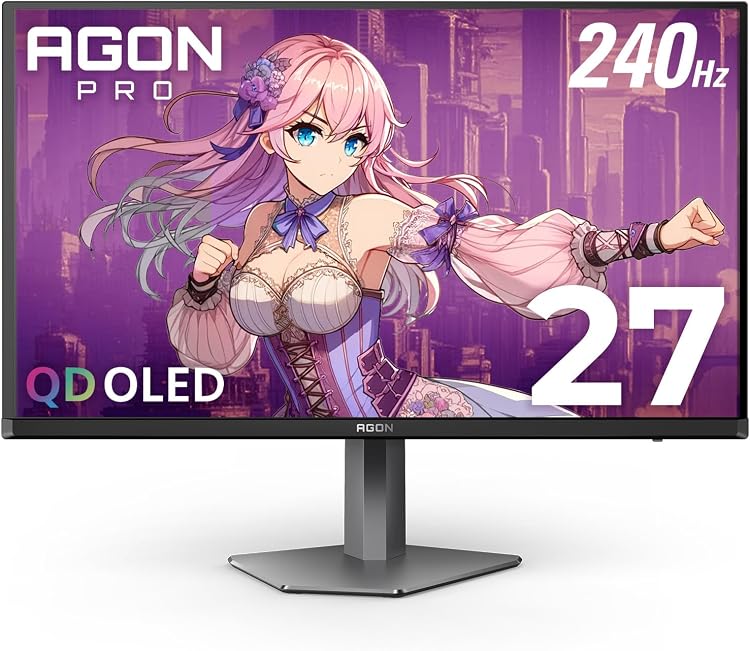
Pros
- Blazing 240Hz and near-instant 0.03ms response ideal for esports and fast shooters
- Outstanding OLED contrast with genuine blacks and wide color gamut
- Solid connectivity including DisplayPort, HDMI, and USB plus Adaptive Sync support
- Ergonomic height-adjustable stand and customizable rear lighting
- Console-friendly performance with high frame rates and low latency
Cons
- OLED panels can risk burn-in if static HUDs or UI elements stay on screen for very long periods
- Built-in speakers are convenient but basic and not a substitute for dedicated audio
- HDR400 peak brightness is solid for dark rooms but less impactful in very bright environments
Panel: 26.5-27 inch QD-OLED, self-emissive
Resolution: QHD 2560x1440
Refresh Rate: 240Hz
Response Time: 0.03ms GtG
HDR: HDR400 True Black
Color: over 1.07 billion colors, 101 percent DCI-P3, 136.7 percent sRGB
Sync: Adaptive Sync and G-Sync compatible
Connectivity: DisplayPort, HDMI, USB, built-in speakers
Ergonomics: height adjustable stand with rear multi-color lighting
Model: AG276QZD2
| Brand | AOC |
|---|---|
| Screen Size | 27 Inches |
| Resolution | QHD Ultra Wide 1440p |
| Aspect Ratio | 1.78:1 |
| Screen Surface Description | Glossy |
Best suited to shoppers comparing monitors products who specifically need 240Hz refresh rate and 0.03ms GtG response deliver ultra-fluid motion so competitive players can react faster with zero blur, QD-OLED self-emissive panel produces perfect….
Before buying, compare the exact model’s compatibility, dimensions, core specifications, warranty, recurring owner feedback, and current price against other monitors options. Retailer availability and pricing can change after publication.

Pros
- Exceptional 0.03ms response and 240Hz for a competitive edge
- Stunning OLED contrast with True Black 400 and high peak brightness
- Future-proof dual HDMI 2.1 and DisplayPort 1.4 connectivity
- Highly adjustable stand and nearly borderless design
- Strong multi-certification eye comfort features
Cons
- Glossy panel can show reflections in brightly lit rooms
- Typical 275-nit brightness may feel limited in very sunny environments
- OLED panels retain some risk of temporary image retention despite care features
Display: 27-inch QHD (2560 x 1440) glossy OLED panel.
Speed: Up to 240Hz refresh rate and 0.03ms GtG response time.
HDR and Color: VESA DisplayHDR True Black 400, up to 98.5% DCI-P3, 1.5M:1 contrast, peak brightness 1300 nits.
Adaptive Sync: NVIDIA G-SYNC Compatible and AMD FreeSync Premium Pro.
Connectivity: Dual HDMI 2.1, DisplayPort 1.4, USB 3.2 upstream plus dual downstream ports.
Ergonomics: Fully adjustable stand (tilt, height, swivel, pivot) and four-side virtually borderless design.
| Aspect Ratio | 16:9 |
|---|---|
| Screen Finish | Glossy |
| Contrast Ratio | 1500000:1 |
| Refresh Rate | 240 Hz |
| Display Type | OLED |
| Display Technology | OLED |
| Viewing Angle | 178 |
| Brightness | 275 Candela per Square Meter |
| Pixel Pitch | 0.2292 |
| Color Gamut | 98.5 |
Best suited to shoppers comparing monitors products who specifically need 240Hz refresh and 0.03ms response deliver ultra-smooth, ghost-free competitive gameplay, Glossy QHD OLED with 98.5% DCI-P3 and True Black 400 for vivid color and….
Before buying, compare the exact model’s compatibility, dimensions, core specifications, warranty, recurring owner feedback, and current price against other monitors options. Retailer availability and pricing can change after publication.

Pros
- Very fast 240Hz refresh rate for fluid competitive gaming
- Extremely low 0.03ms GtG response time helps minimize motion blur
- QD OLED panel delivers deep blacks, high contrast, and vibrant colors
- QHD resolution offers a sharp image while remaining less demanding than 4K
- Adaptive-Sync and G-SYNC compatibility support smoother gameplay
Cons
- QD OLED displays can require extra care with prolonged static images because of potential image retention or burn-in concerns
- HDR performance is certified to HDR400 True Black, so it may not match the brightness of premium high-end HDR monitors
- The 240Hz refresh rate is most useful with a powerful gaming PC capable of producing high frame rates
| Color | Black |
|---|---|
| Size | 27" 240Hz AOC Gaming |
| Dimensions | 7.5 x 23.99 x 17.89 inches |
| Weight | 17.70091501598 pounds |
| Product Group | Personal Computer |
| Binding | Personal Computers |
Best suited to shoppers comparing monitors products who specifically need see sharper game detail with QHD 2560 x 1440 resolution on a spacious 27-inch display., Track fast-moving opponents more clearly with a 240Hz refresh….
Before buying, compare the exact model’s compatibility, dimensions, core specifications, warranty, recurring owner feedback, and current price against other monitors options. Retailer availability and pricing can change after publication.

Pros
- Sharp 4K UHD resolution with OLED contrast, color range, and response
- Extremely light and thin for true travel-friendly portability
- Versatile 60W USB-C two-way power and video over one cable
- Portrait and landscape modes with integrated stand and cover
- Broad device support including Windows, Mac, Chrome, Android, iOS, and consoles
Cons
- 60Hz refresh rate is modest for competitive or high-frame-rate gaming
- OLED panels can risk burn-in with prolonged static UI elements
- Fewer ports and features than a full-size desktop monitor
Screen: 15.6-inch 4K UHD (3840x2160) OLED portable panel with 60Hz refresh rate. Thickness about 0.6 inches and weight under 1.5 pounds for easy transport.
Connectivity: dual USB-C with 60W two-way power and video, mini HDMI, and 3.5mm headphone jack. Compatible with Windows, macOS, Chrome OS, Android, iOS, and game consoles.
Design extras: built-in kickstand for portrait and landscape, protective screen cover, integrated tripod mount, Flicker-Free technology, and blue light filter. Backed by ViewSonic 3-year coverage with US-based support.
| Aspect Ratio | 16:9 |
|---|---|
| Screen Finish | Matte |
| Contrast Ratio | 80,000,000:1 |
| Refresh Rate | 60 Hz |
| Display Type | OLED |
| Display Technology | OLED |
| Viewing Angle | 170 Degrees |
| Brightness | 400 |
| Pixel Pitch | 0.18 |
| Color Gamut | 1.07 |
Best suited to shoppers comparing monitors products who specifically need true 4K OLED visuals deliver four times Full HD detail with deep contrast for work and play on the go, Ultra-portable design at 0.6….
Before buying, compare the exact model’s compatibility, dimensions, core specifications, warranty, recurring owner feedback, and current price against other monitors options. Retailer availability and pricing can change after publication.
How to Choose the Best Oled Monitor For Video Editing
Resolution and Canvas Workspace
Resolution dictates timeline usability and preview fidelity. A 4K UHD (3840 x 2160) canvas allows editors to preview native 4K video while leaving room for workspace tools, audio meters, and media bins. On smaller screens or lower budgets, 1440p remains viable for 1080p mastering, but native 4K monitoring requires higher pixel density to judge compression artifacts accurately.
Text clarity also shifts with resolution on OLED panels. Certain subpixel configurations cause fringing on user interface text and thin vector tracks, making higher PPI panels preferable. Learn more about layout readability in our review of oled monitor text clarity.
Color Gamut Coverage and Calibration
Video editing demands precise gamut coverage across standards like Rec. 709, DCI-P3, and Rec. 2020. QD-OLED panels typically offer superior color volume compared to standard displays, covering up to 99% of DCI-P3 with factory-calibrated Delta E < 2 or Delta E < 1 ratings.
Hardware calibration allows lookup tables (LUTs) to write directly to monitor hardware rather than relying solely on OS profiles. This guarantees consistent color output regardless of the host machine or editing suite used.
HDR Capabilities and Luminance Consistency
High-end video production often requires mastering in HDR formats like HDR10, HLG, and Dolby Vision. VESA DisplayHDR True Black 400 certification ensures deep baseline black levels without blooming around bright subtitle text or high-contrast highlights.
Automatic Brightness Limiter (ABL) behavior is an important consideration. Aggressive dimming algorithms shift full-screen brightness when switching between bright scenes and dark cuts. Displays with uniform brightness toggles keep luminance consistent, preventing false perceptual shifts during grading sessions.
Connectivity and Power Delivery
Video editors using mobile workstations require flexible high-bandwidth ports. Modern editing monitors integrate USB Type-C or Thunderbolt connections supplying video, data, and up to 90W or 96W Power Delivery via a single cable. This eliminates external power bricks on multi-monitor editing desks.
For dual-system setups handling both rendering and editing tasks, integrated KVM switches and HDMI 2.1 ports streamline workflow changes. Compare specific interface constraints in our breakdown of usb-c vs thunderbolt monitor setups.
Burn-in Mitigation and Thermal Design
Editing interfaces contain static graphic elements: gray track lines, playheads, timecodes, and persistent menus. These assets present higher burn-in risks over sustained multi-hour sessions than dynamic video games.
Manufacturers counter this risk using hardware heat management and firmware safeguards. Graphene films, passive custom heatsinks, pixel shifting, and sub-logo dimming protect organic emitter layers without introducing fan noise on set or in audio suites.
| Model | Display Type & Resolution | Gamut Coverage | Connectivity | Best For |
|---|---|---|---|---|
| ASUS ProArt PA27UCDMR 27 Inch 4K 240Hz OLED | 26.5″ 4K QD-OLED (3840×2160) | 99% DCI-P3, 100% sRGB, Rec. 2020 | Dual Thunderbolt 4 (96W PD), HDMI 2.1, DP 1.4 | Color-Critical Studio Grading |
| ASUS ROG Swift 32” 4K OLED Gaming Monitor | 32″ 4K QD-OLED (3840×2160) | 99% DCI-P3, Delta E < 2 | USB-C (90W PD), HDMI 2.1, DP 1.4 | High-Resolution Hybrid Production |
| msi MPG 321URX QD-OLED, 32″ 4K UHD Quantum Dot | 31.5″ 4K QD-OLED (3840×2160) | 99% DCI-P3, Delta E ≤ 2 | USB-C (90W PD), HDMI 2.1, DP 1.4a | Large-Format Video Editing Value |
| Samsung 27” Odyssey OLED G5 (G50SF) | 27″ QHD QD-OLED (2560×1440) | Pantone Validated (2100+ colors) | HDMI, DisplayPort | Budget 1440p Editing & Gaming |
| ViewSonic VX1655-4K-OLED 15.6 Inch 4K | 15.6″ 4K OLED (3840×2160) | High 4K Density | USB-C (60W PD), Mini HDMI | On-Location & Mobile Field Monitoring |
| LG 27GX704A-B 27-inch Ultragear QHD (2650×1440) | 27″ QHD OLED (2560×1440) | 98.5% DCI-P3 | Dual HDMI 2.1, DP 1.4, USB 3.2 Hub | Glossy Contrast Workflows |
| AOC 27 Inch OLED Gaming Monitor (QD-OLED) | 27″ QHD QD-OLED (2560×1440) | 110% DCI-P3, 147% sRGB | HDMI 2.1, DP 1.4, USB 3.2 Hub | Affordable Wide-Gamut Production |
How We Evaluated
We evaluated these monitors by systematically comparing manufacturer specifications, verified technical datasheets, color space certifications, and connectivity standards. Each display was assessed against the practical requirements of modern NLEs (non-linear editors) including DaVinci Resolve, Adobe Premiere Pro, and Final Cut Pro. Read about our standard processes on our review methodology page.

Why You Should Trust PCGearWiki
PCGearWiki provides objective hardware analysis grounded strictly in manufacturer documentation, engineering standards, and verified performance metrics. We avoid vague marketing claims, evaluating displays through the lens of concrete interface support, thermal management solutions, and verifiable color accuracy ratings.
Our recommendations focus on workflow efficiency, long-term durability, and overall value. While we earn affiliate commissions through retail links, our editorial assessments remain completely independent and data-focused.
Final Thoughts
Best Overall: ASUS ProArt PA27UCDMR 27 Inch 4K 240Hz OLED. This panel is built explicitly for creative professionals, featuring hardware calibration write-back, Delta E < 1 color accuracy, dual Thunderbolt 4 with 96W PD, and HDR format coverage including Dolby Vision, HLG, and HDR10. It is the definitive pick for colorists, though its high price makes it unsuitable for hobbyists.
Best Value: msi MPG 321URX QD-OLED, 32″ 4K UHD Quantum Dot. Offering a spacious 31.5-inch 4K QD-OLED panel, 99% DCI-P3 color gamut, factory Delta E ≤ 2 accuracy, and 90W USB Type-C power delivery, this model delivers extensive workspace real estate at an accessible tier. Skip it if you require dedicated ProArt hardware calibration tools.
Best Budget: Samsung 27” Odyssey OLED G5 (G50SF). Featuring Pantone-validated color reproduction, QD-OLED contrast, and thermal modulation burn-in defense at an entry-level price, it is great for 1080p and 1440p editing workflows. Skip it if native 4K timeline monitoring is essential.
Best Mobile / Portable: ViewSonic VX1655-4K-OLED 15.6 Inch 4K. Weighing just 1.5 lbs, this ultra-compact 4K OLED monitor is ideal for field monitoring, mobile laptop suites, or secondary color preview panels. Skip it if you need a primary high-refresh editing canvas.
To evaluate alternative displays for general desk tasks, explore our roundup of the best oled monitor for productivity.
Frequently Asked Questions
Is an OLED display safe from burn-in when used for video editing?
Modern OLED monitors include protective mechanisms like pixel shifting, automatic static logo dimming, and passive graphene heatsinks to reduce heat accumulation. While persistent editing UI elements carry theoretical risks, following manufacturer care cycles and using auto-hiding panels significantly mitigates degradation over typical lifespans.
Is 4K resolution necessary on an OLED monitor for video editing?
A 4K display is highly advantageous because it allows 1:1 pixel rendering of Ultra HD footage while keeping application bins and scopes accessible on screen. 1440p displays can function for editing 1080p footage, but 4K screens eliminate scaling artifacts when reviewing high-resolution masters.
Do I need Thunderbolt or USB-C on a video editing monitor?
USB-C and Thunderbolt provide single-cable data transmission, display signal, and substantial power delivery up to 96W for connected laptops. This simplifies high-bandwidth studio configurations, though standard DisplayPort 1.4 and HDMI 2.1 connections remain completely sufficient for desktop tower workflows.
How does QD-OLED differ from standard OLED for video production?
QD-OLED combines blue organic light emitters with quantum dot layers, resulting in higher peak color luminance and broader color volume across the DCI-P3 and Rec. 2020 gamuts. This ensures bright saturated colors do not wash out compared to WRGB panel designs.
What should I budget for a color-accurate OLED editing monitor?
Entry-level 1440p OLED panels start around $350, offering rich contrast and wide gamuts for hobbyists. Professional 4K displays featuring hardware calibration, extensive HDR profile support, and Thunderbolt hubs typically range between $800 and $1,300.
Sources and Verification
Research basis: Product identity, dimensions, interfaces, supported features, and warranty terms are checked against available manufacturer documentation and current retailer listings. Price, stock, and aggregate customer ratings can change after publication.
Primary references for this guide: VESA DisplayHDR testing and certification.
Testing disclosure: Unless this article explicitly states that PCGearWiki performed hands-on testing and describes the test setup, recommendations are research-based editorial evaluations rather than PCGearWiki laboratory measurements. Customer feedback is used to identify recurring ownership patterns, not as proof of technical performance.
Last source review: September 22, 2026. See our Review Methodology, Editorial Policy, and Corrections Policy.


Write Your Review
No reviews yet. Be the first to share your experience!