

Last updated: October 13, 2026
Video editing workloads depend directly on processor multi-threading, integrated media encoders, dedicated graphics compute, and high memory bandwidth. Professional 4K multi-stream editing requires minimum 16GB to 32GB RAM paired with discrete GPU acceleration. Entry-level 1080p cutting allows budget hardware with integrated graphics engines, provided proxy workflows handle timeline playback.
Hardware Requirements Comparison
Different project resolutions and codecs impose distinct demands on mobile hardware. Evaluate project scope before choosing device class.
| Editing Tier | Target Resolution / Codec | Minimum CPU / GPU | Minimum Memory | Storage Target |
|---|---|---|---|---|
| Entry / Social | 1080p H.264 / basic cuts | 4-core modern CPU / basic iGPU | 8GB unified/system | 512GB NVMe |
| Intermediate | 4K H.264 / 10-bit H.265 | 6-core to 8-core CPU / Mid-tier dGPU | 16GB to 32GB | 1TB NVMe |
| Advanced / Pro | 4K/6K ProRes, RAW, REDCODE | 8+ core CPU / High-tier dGPU (8GB+ VRAM) | 32GB to 64GB | 2TB NVMe + external scratch |
Users balancing creative tasks like illustration alongside video can cross-reference our guide to the best laptops for artists. For workflows strictly avoiding touch interfaces, examine the best non touch screen laptops.
Selection Criteria for Editing Laptops
Timeline performance relies on specific component interactions rather than broad benchmark claims. Base selection on these verified technical factors:
- CPU Single-Core vs Multi-Core: Timeline scrubbing and user interface responsiveness rely heavily on single-thread frequency. Final export rendering and software decoding scale with physical core count.
- Hardware Encoders/Decoders: Dedicated silicon blocks like Intel Quick Sync or AMD Video Codec Engine process H.264 and HEVC files without taxing compute cores. Without hardware decoding, timeline playback stutters.
- RAM Capacity and Bandwidth: High-resolution timelines cache uncompressed frames directly to system memory. 8GB suits basic assembly. 16GB prevents out-of-memory crashes on layered timelines. 32GB or more handles complex color grading and compositing.
- VRAM Allocations: GPU-accelerated effects, OpenCL, and CUDA processing require discrete video memory. Insufficient VRAM causes playback buffer errors in Davinci Resolve or Premiere Pro.
- Display Accuracy: Panels must hit verified coverage thresholds (minimum 100% sRGB for web video; DCI-P3 for HDR delivery) to prevent color distortion during export grading.
For office spaces needing fixed rendering stations rather than mobile laptops, explore compact configurations via the best mini PC for home office guide.
Approved Configuration Analysis
This entry represents specification-based analysis from approved live product listings, not hands-on lab measurements.
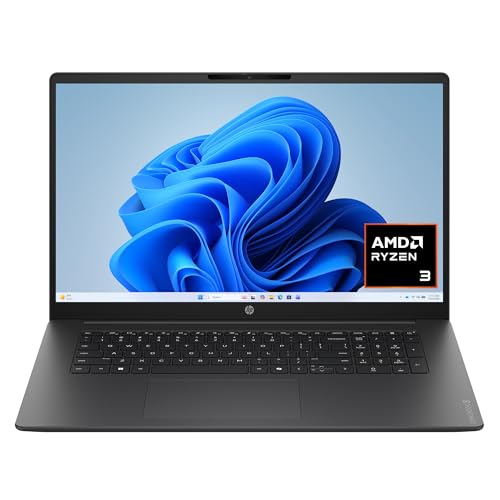
[acms_product asin=”B0GQB1LPTR”]HP OmniBook 3 17.3 inch Laptop PC, FHD Display
HP OmniBook 3 delivers expansive 17.3-inch Full HD IPS workspace on entry-level budget. System features AMD Ryzen 3 30 processor, integrated AMD Radeon 610M graphics, 8GB LPDDR5 RAM, and 512GB PCIe NVMe M.2 SSD. Verify live pricing on product card.
Large screen provides spacious timeline viewing without external monitor. Integrated AMD Radeon 610M graphics provides basic media decoding. LPDDR5 memory offers high bandwidth, though 8GB capacity restricts workload scope. 512GB NVMe storage yields rapid boot times and acceptable clip caching speed for small projects.
Hardware operates strictly inside entry-level parameters. 8GB non-expandable memory limits editing to basic 1080p cuts, social clips, and rough assemblies. Layered multi-cam tracks, heavy fusion compositions, or native 4K 10-bit footage will exhaust frame buffers. System requires lightweight proxies to maintain fluid timeline scrubbing.
Video Editing Laptop Pre-Purchase Checklist
- Verify RAM configuration. Ensure memory meets software minimums (DaVinci Resolve requires 16GB minimum; 8GB limits software stability).
- Check panel color space specifications. Budget panels often cover only 45% NTSC (~60% sRGB), causing inaccurate color grades.
- Inspect port selection. High-resolution raw footage transfers require USB 3.2 Gen 2 (10Gbps) or Thunderbolt/USB4 connections to external scratch disks.
- Confirm power delivery specifications. Laptops throttle CPU/GPU clock speeds under heavy rendering loads when running on battery power.
Frequently Asked Questions
Can laptop with 8GB RAM edit video?
Yes, for basic 720p and 1080p timelines with cut-and-splice operations. Software like DaVinci Resolve or complex Premiere Pro sequences will encounter memory allocation errors or severe paging slowdowns with multiple video layers.
Do you need dedicated GPU for video editing?
Dedicated GPU becomes mandatory for real-time color grading, temporal noise reduction, hardware-accelerated effects, and 4K playback. Basic 1080p H.264 cuts can function entirely on integrated GPU hardware decoders.
Why do timeline scrub rates drop on 4K footage?
Highly compressed formats like 10-bit 4:2:2 HEVC lack native hardware decoding on budget GPUs. System CPU decodes every frame in software, causing stutter. Generating ProRes or DNxHR proxies eliminates this bottleneck.
Pros
- Large, vibrant FHD IPS display is well suited to productivity and entertainment.
- Fast 512GB NVMe SSD provides responsive startup and generous everyday storage.
- Long claimed battery life with convenient HP Fast Charge support.
- FHD HDR webcam and AI noise reduction improve the video conferencing experience.
- Modern wireless connectivity with Wi-Fi 6 and Bluetooth 5.4.
Cons
- AMD Radeon 610M integrated graphics are intended for casual gaming and everyday visuals, not demanding AAA gaming.
- The 17.3-inch form factor offers a roomy workspace but is less portable than a typical 13- or 15-inch laptop.
- The 8GB memory configuration may feel limiting for heavy multitasking, advanced editing, or other demanding workloads.
| Color | Mica silver cover and keyboard frame, iron gray ba |
|---|---|
| Dimensions | 15.65 x 10.09 x 0.65 inches |
| Weight | 4.43 Pounds |
| Product Group | Personal Computer |
| Binding | Personal Computers |
Best suited to shoppers comparing traditional laptops products who specifically need enjoy a spacious 17.3-inch FHD IPS display with wide 178-degree viewing angles for comfortable work, streaming, and browsing., Handle everyday multitasking, office apps, streaming,….
Before buying, compare the exact model’s compatibility, dimensions, core specifications, warranty, recurring owner feedback, and current price against other traditional laptops options. Retailer availability and pricing can change after publication.
Add PCGearWiki as a preferred source on Google
Sources and Verification
Research basis: Product identity, dimensions, interfaces, supported features, and warranty terms are checked against available manufacturer documentation and current retailer listings. Price, stock, and aggregate customer ratings can change after publication.
Testing disclosure: Unless this article explicitly states that PCGearWiki performed hands-on testing and describes the test setup, recommendations are research-based editorial evaluations rather than PCGearWiki laboratory measurements. Customer feedback is used to identify recurring ownership patterns, not as proof of technical performance.
Last source review: October 13, 2026. See our Review Methodology, Editorial Policy, and Corrections Policy.




Write Your Review
No reviews yet. Be the first to share your experience!