

Last updated: September 22, 2026
Quick picks
- Top Pick: XFX Swift AMD Radeon RX 9060 XT 9.7 Outstanding
- Highest Score: GIGABYTE Radeon RX 9060 XT Gaming OC 9.9 Outstanding
Selecting best amd gpu for gaming requires balancing raw compute speed against VRAM buffer size and power budget. Gamers targeting 1440p require 16GB memory to prevent texture stutter, while entry-level cards face memory bottlenecks in modern releases. Power supply capacity and case clearance dictate realistic card selection.

Graphics cards define rendering speed, display output options, thermal output, system power requirements. Upgrading existing desktop or building new gaming rig requires evaluating architecture generations, compute unit counts, memory bandwidth, cooling capacity. Guide evaluates 10 graphics cards from MAXSUN, SAPPHIRETechnology, XFX and more across entry-level 1080p, midrange 1440p, high-tier 4K performance profiles as of September 2026.
Analysis evaluates manufacturer specifications, silicon architecture differences, bus widths, cooling solutions, board dimensions. Pair high-performance GPU hardware with proper display technology reviewed in our ultrawide monitor guide. Evaluation follows technical benchmarking standards outlined in PCGearWiki review methodology.
Compare at a Glance
| # | Product | Editorial Score | Graphics Coprocessor | Graphics Card Ram |
|---|---|---|---|---|
| 1 | XFX Swift AMD Radeon RX 9060 XT | 9.7 Outstanding | RX 9060 XT | 16 GB |
| 2 | GIGABYTE Radeon RX 9060 XT Gaming OC | 9.9 Outstanding | RX 9060XT | 16 GB |
| 3 | SAPPHIRE AMD Radeon RX 7900 XT 20GB | 9.7 Outstanding | AMD Radeon RX 7900 XT | 20 GB |
| 4 | GIGABYTE Radeon RX 9070 XT Gaming OC | 9.7 Outstanding | AMD Radeon RX 9070 XT | 16 GB |
| 5 | ASRock Radeon RX 7700 XT Challenger 12GB | 9.6 Outstanding | AMD Radeon RX 7700 XT | 12 GB |
| 6 | ASUS Prime Radeon RX 9070 XT 16GB | 9.5 Outstanding | AMD RX9070 | 16 GB |
| 7 | MOUGOL AMD Radeon RX 580 8GB GDDR5 | 9.9 Outstanding | AMD Radeon RX 580 | 8 GB |
| 8 | XFX Speedster SWFT210 Radeon RX 7600 8GB | 9.9 Outstanding | AMD Radeon RX 7600 | 8 GB |
| 9 | XFX Swift AMD Radeon RX 9060 XT | 9.9 Outstanding | RX 9060 XT | 16 GB |
| 10 | MAXSUN AMD Radeon RX 550 4GB GDDR5 | 9.9 Outstanding | AMD Radeon RX 550 | 4 GB |

Pros
- High boost clock for improved frame rates
- 16GB GDDR6 for handling large textures and multitasking
- Triple fan cooling maintains lower temperatures
- Overclocked model provides extra performance
- Compatible with standard desktop PCs
Cons
- Triple fan design requires sufficient space in the PC case
- Exclusively for desktop systems, limiting versatility
- May demand a high-quality power supply for optimal function
| Graphics Coprocessor | RX 9060 XT |
|---|---|
| Graphics Card Ram | 16 GB |
| GPU Clock Speed | 1900 MHz |
| Video Output Interface | DisplayPort, HDMI |
| Graphics Ram Type | GDDR6 |
| Compatible Devices | Desktop |
| Graphics Card Interface | PCI-Express x16 |
| Memory Clock Speed | 20 GHz |
| Display Maximum Resolution | 4K UHD (3840x2160) |
| Display Resolution Maximum | 3840x2160 |
Best suited to shoppers comparing graphics cards products who specifically need unlock high-performance gaming with RDNA 4 architecture and boost clocks reaching 3320 MHz., Ensure stable operation through effective heat dissipation from the triple fan….
Before buying, compare the exact model’s compatibility, dimensions, core specifications, warranty, recurring owner feedback, and current price against other graphics cards options. Retailer availability and pricing can change after publication.
Pros
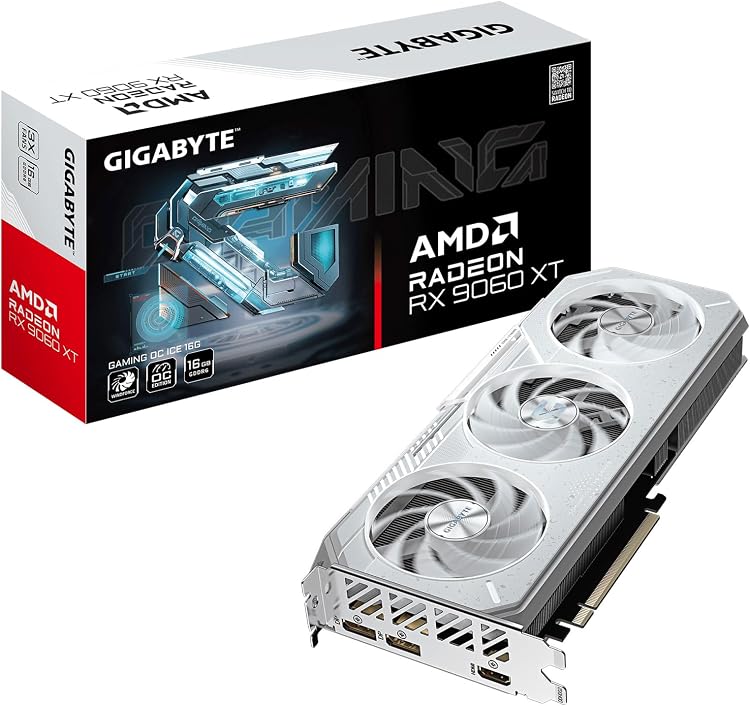
- Generous 16GB GDDR6 VRAM handles demanding games and creative workloads
- Advanced WINDFORCE cooling combines copper heat pipes, 3D fans and screen cooling
- Reinforced structure and metal backplate add physical stability
- Dual BIOS provides flexible performance or quiet operation choices
Cons
- 128-bit memory bus may limit bandwidth in certain high-end scenarios
- Two-slot design could restrict airflow in compact cases
- Zero customer reviews available to confirm real-world reliability
| Graphics Coprocessor | RX 9060XT |
|---|---|
| Graphics Card Ram | 16 GB |
| GPU Clock Speed | 2780 MHz |
| Video Output Interface | DisplayPort, HDMI |
| Graphics Ram Type | GDDR6 |
| Compatible Devices | Desktop |
| Graphics Card Interface | PCI-Express x16 |
| Memory Clock Speed | 20000 MHz |
| Number of Fans | 3 |
| Display Maximum Resolution | 3840 x 2160 |
Best suited to shoppers comparing graphics cards products who specifically need unlock high-resolution gaming and AI tasks with 16GB GDDR6 memory and RDNA 4 architecture, Maintain cool and quiet operation via WINDFORCE system with alternate-spinning….
Before buying, compare the exact model’s compatibility, dimensions, core specifications, warranty, recurring owner feedback, and current price against other graphics cards options. Retailer availability and pricing can change after publication.
Pros
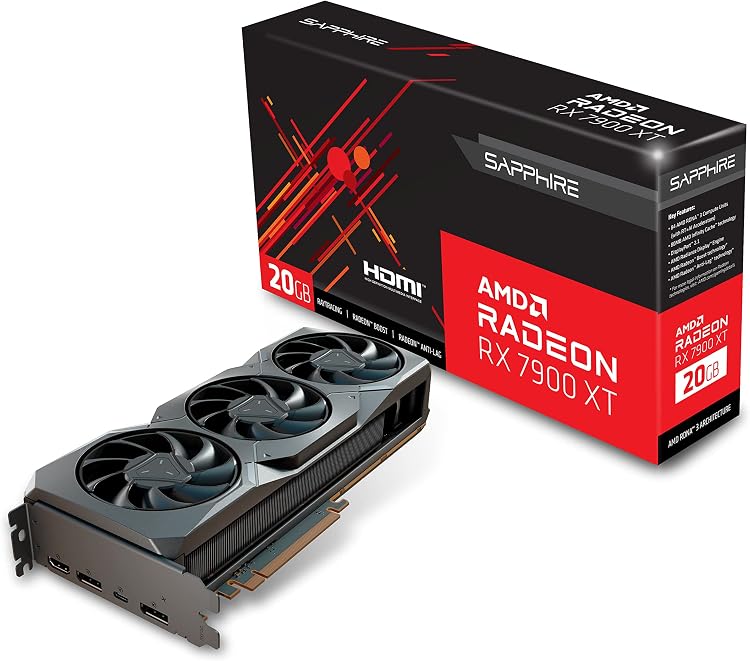
- Large 20GB memory capacity supports intensive multitasking and content creation
- Advanced RDNA 3 chiplet design improves performance efficiency and raytracing
- Multiple display outputs including USB-C provide flexible connectivity options
Cons
- 3-slot ATX design requires a spacious case for proper installation and airflow
- Best performance achieved only in systems with PCIe 4.0 support
- Targeted primarily at users needing high-end AMD GPU capabilities rather than entry-level builds
| Graphics Coprocessor | AMD Radeon RX 7900 XT |
|---|---|
| Graphics Card Ram | 20 GB |
| Video Output Interface | DisplayPort, HDMI, USB |
| Graphics Ram Type | GDDR6 |
| Compatible Devices | Desktop |
| Graphics Card Interface | PCI-Express x16 |
| Memory Clock Speed | 20 GHz |
| Number of Fans | 3 |
| GPU Series | AMD Radeon RX 7000 Series |
| Display Resolution Maximum | 7680x4320 |
Best suited to shoppers comparing graphics cards products who specifically need unlock next-level gaming visuals through AMD RDNA 3 architecture with improved raytracing accelerators, Process complex 8K textures and 3D environments smoothly using 20GB of….
Before buying, compare the exact model’s compatibility, dimensions, core specifications, warranty, recurring owner feedback, and current price against other graphics cards options. Retailer availability and pricing can change after publication.

Pros
- Strong cooling for sustained performance
- Generous 16GB memory for modern games
- RGB lighting adds visual appeal
- Durable build with advanced thermal materials
Cons
- Large size may not fit smaller cases
- High power draw requires robust PSU
- Advanced features unnecessary for basic use
| Graphics Coprocessor | AMD Radeon RX 9070 XT |
|---|---|
| Graphics Card Ram | 16 GB |
| GPU Clock Speed | 3060 MHz |
| Video Output Interface | DisplayPort |
| Graphics Ram Type | GDDR6 |
| Compatible Devices | Desktop |
| Graphics Card Interface | PCI-Express x16 |
| Memory Clock Speed | 2600 GHz |
| Display Maximum Resolution | 7680 x 4320 |
| Display Resolution Maximum | 7680x4320 |
Best suited to shoppers comparing graphics cards products who specifically need enables smooth high-resolution gaming with Radeon RX 9070 XT power, Keeps temperatures low during extended sessions via WINDFORCE system.
Before buying, compare the exact model’s compatibility, dimensions, core specifications, warranty, recurring owner feedback, and current price against other graphics cards options. Retailer availability and pricing can change after publication.

Pros
- High 12GB GDDR6 memory capacity supports 4K gaming and content creation
- 0dB silent cooling enables noise-free idle and light workloads
- Metal backplate improves build quality and thermal performance
- Multiple modern display outputs allow flexible multi-monitor setups
- Strong clock speeds deliver solid performance for the RDNA 3 generation
Cons
- Not compatible with all pre-built systems and requires case and PSU verification
- Dual 8-pin power connectors demand a sufficiently rated power supply
- Larger board dimensions may limit fit in compact chassis
- No customer reviews available to confirm real-world reliability
| Graphics Coprocessor | AMD Radeon RX 7700 XT |
|---|---|
| Graphics Card Ram | 12 GB |
| Video Output Interface | DisplayPort |
| Graphics Ram Type | GDDR6 |
| Compatible Devices | Desktop |
| Graphics Card Interface | PCI-Express x16 |
| Memory Clock Speed | 18000 MHz |
| Number of Fans | 2 |
| Display Maximum Resolution | 7680 x 4320 |
| Display Resolution Maximum | 7680x4320 Pixels |
Best suited to shoppers comparing graphics cards products who specifically need deliver smooth high-resolution gaming with RDNA 3 architecture and fast boost clocks for responsive frame rates in demanding titles, Maintain quiet operation during everyday….
Before buying, compare the exact model’s compatibility, dimensions, core specifications, warranty, recurring owner feedback, and current price against other graphics cards options. Retailer availability and pricing can change after publication.

Pros
- Strong thermal design with multiple cooling enhancements for reliable operation
- Durable components including ball bearings and protective backplate
- Dual BIOS provides user choice between cooling and noise levels
- 0dB fan mode enables quiet performance at lower loads
Cons
- 2.5-slot size may limit options in very compact PC cases
- Performance BIOS mode can increase fan noise under heavy load
- Requires compatible PCIe 5.0 system and sufficient power supply
| Graphics Coprocessor | AMD RX9070 |
|---|---|
| Graphics Card Ram | 16 GB |
| GPU Clock Speed | 4000 MHz |
| Video Output Interface | Native DisplayPort 2.1a x 3, Native HDMI 2.1b |
| Graphics Ram Type | GDDR6 |
| Compatible Devices | Desktop |
| Graphics Card Interface | PCI-Express x16 |
| Memory Clock Speed | 4000 MHz |
| Number of Fans | 3 |
| Display Maximum Resolution | 7680 x 4320 |
Best suited to shoppers comparing graphics cards products who specifically need delivers consistent cooling during extended gaming sessions through upgraded Axial-tech fans and vented backplate, Reduces noise with 0dB technology that stops fans below 55°C….
Before buying, compare the exact model’s compatibility, dimensions, core specifications, warranty, recurring owner feedback, and current price against other graphics cards options. Retailer availability and pricing can change after publication.

Pros
- Strong triple-display connectivity options
- Compact size suits smaller PC builds
- Adequate 8GB VRAM for 1080p gaming and multitasking
- Dual-fan cooling helps control temperatures
Cons
- Older 14nm architecture limits efficiency compared to newer GPUs
- Requires a separate 6-pin power connector
- No customer reviews available to verify real-world reliability
| Graphics Coprocessor | AMD Radeon RX 580 |
|---|---|
| Graphics Card Ram | 8 GB |
| GPU Clock Speed | 1206 MHz |
| Video Output Interface | DVI, DisplayPort, HDMI |
| Graphics Ram Type | GDDR5 |
| Compatible Devices | Desktop |
| Graphics Card Interface | PCI-Express x16 |
| Memory Clock Speed | 1500 MHz |
| Number of Fans | 2 |
| Display Maximum Resolution | 3840 x 2160 |
Best suited to shoppers comparing graphics cards products who specifically need deliver smooth 1080p gameplay in popular titles without memory bottlenecks from 8GB high-capacity VRAM, Connect up to three monitors at once for expanded productivity….
Before buying, compare the exact model’s compatibility, dimensions, core specifications, warranty, recurring owner feedback, and current price against other graphics cards options. Retailer availability and pricing can change after publication.

Pros
- Strong gaming performance from RDNA 3 chipset
- Effective dual fan cooling solution
- Versatile connectivity options
- Good value for 1080p and 1440p gaming
Cons
- Dual fans may limit extreme overclocking potential
- 8GB memory can constrain 4K gaming in some titles
- Requires adequate case airflow for optimal operation
| Graphics Coprocessor | AMD Radeon RX 7600 |
|---|---|
| Graphics Card Ram | 8 GB |
| Video Output Interface | HDMI |
| Graphics Ram Type | GDDR6 |
| Compatible Devices | Desktop |
| Graphics Card Interface | PCI Express |
| Memory Clock Speed | 17.5 GHz |
| Number of Fans | 2 |
| GPU Series | AMD Radeon RX 7000 Series |
| Display Resolution Maximum | 7680x4320 |
Best suited to shoppers comparing graphics cards products who specifically need powers immersive gaming with ultra-high frame rates via AMD RDNA 3 architecture, Maintains stable performance through efficient dual fan cooling during extended sessions.
Before buying, compare the exact model’s compatibility, dimensions, core specifications, warranty, recurring owner feedback, and current price against other graphics cards options. Retailer availability and pricing can change after publication.

Pros
- High memory capacity handles demanding games and multitasking
- Strong boost clock supports high frame rates
- Dual fan cooling promotes reliable thermal performance
Cons
- Dual fan setup can increase noise during heavy loads
- Requires a compatible desktop PC with adequate power and space
- High-end specs may exceed needs for basic computing tasks
| Graphics Coprocessor | RX 9060 XT |
|---|---|
| Graphics Card Ram | 16 GB |
| GPU Clock Speed | 1900 MHz |
| Video Output Interface | DisplayPort, HDMI |
| Graphics Ram Type | GDDR6 |
| Compatible Devices | Desktop |
| Graphics Card Interface | PCI-Express x16 |
| Memory Clock Speed | 20 GHz |
| Number of Fans | 2 |
| Display Maximum Resolution | 3840 x 2160 |
Best suited to shoppers comparing graphics cards products who specifically need powers smooth high-resolution gaming with ample 16GB GDDR6 memory, Achieves faster frame rates via boost clock up to 3320 MHz.
Before buying, compare the exact model’s compatibility, dimensions, core specifications, warranty, recurring owner feedback, and current price against other graphics cards options. Retailer availability and pricing can change after publication.

Pros
- Energy efficient operation with minimal power connectors required
- Versatile connectivity options for mixed monitor setups
- Reliable for everyday tasks like video editing and light CAD work
- Quiet fan design maintains low noise during use
Cons
- Older 14nm Polaris architecture limits performance in demanding modern games
- 4GB GDDR5 memory may bottleneck at higher settings or resolutions
- Lacks advanced features found in newer GPU generations
| Graphics Coprocessor | AMD Radeon RX 550 |
|---|---|
| Graphics Card Ram | 4 GB |
| GPU Clock Speed | 1183 MHz |
| Video Output Interface | DVI, DisplayPort, HDMI |
| Graphics Ram Type | GDDR5 |
| Compatible Devices | Desktop, MAC, PC |
| Graphics Card Interface | PCI-Express x16, PCI-Express x8 |
| Memory Clock Speed | 6000 MHz |
| Number of Fans | 1 |
| Display Maximum Resolution | 7680 x 4320 |
Best suited to shoppers comparing graphics cards products who specifically need enables smooth 1080p gaming with efficient power management for casual play, Low 50W TDP reduces heat and noise while extending system lifespan.
Before buying, compare the exact model’s compatibility, dimensions, core specifications, warranty, recurring owner feedback, and current price against other graphics cards options. Retailer availability and pricing can change after publication.
How to Choose the Best Amd Gpu For Gaming
Rasterization Performance
Rasterization throughput determines standard game rendering performance without ray tracing overhead. Silicon core architecture, stream processor count, engine clock frequencies govern raw frame output. Modern RDNA 4 models like XFX Swift AMD Radeon RX 9060 XT OC Triple Fan push boost clocks up to 3320 MHz, driving ultra-high frame rates in competitive multiplayer titles.
RDNA 3 architecture models remain potent for standard rendering workloads. Sapphire 21323-01-20G AMD Radeon RX 7900 XT leverages 84 compute units to process complex game geometry effortlessly at native 1440p and 4K resolutions. Cards with higher shader counts sustain stable frame delivery during complex alpha effect passes, volumetric particle rendering, dense draw call sequences.
Budget architectures face raster limits in contemporary game engines. Legacy silicon like MOUGOL AMD Radeon RX 580 Gaming Graphics Card relies on 2048 stream processors clocked at 1206 MHz on 14nm FinFET fabrication. Card sustains playable rates in esports titles like Valorant or CS2, but drops frames under modern Unreal Engine 5 raster loads. Competitive gamers require minimum 2500 MHz boost clocks for high-refresh panels.
Ray Tracing Performance
Hardware ray tracing performance relies heavily on dedicated silicon traversal hardware. AMD RDNA 4 architecture introduces revised Ray Tracing Accelerators inside compute units to reduce BVH traversal penalties. ASUS Prime AMD Radeon RX 9070 XT 16GB GDDR6 OC processes real-time global illumination, ambient occlusion, hybrid reflections with smaller performance drops than older generation equivalents.
RDNA 3 generation hardware handles light to moderate ray tracing pipelines effectively. ASRock AMD Radeon RX 7700 XT Challenger 12GB GDDR6 packs 54 Compute Units with dedicated RT and AI accelerators, producing reliable frame times at 1080p with medium ray traced reflections enabled. Increasing resolution to 1440p requires lowering reflection quality settings to avoid severe frame pacing spikes.
Legacy architectures lack dedicated hardware BVH intersection calculation units entirely. Cards like maxsun AMD Radeon RX 550 4GB GDDR5 ITX Computer PC rely on basic shader arrays, making ray tracing pipelines completely unplayable. Gamers prioritizing path tracing or heavy hardware ray reflection effects should choose RDNA 4 series silicon exclusively.
VRAM Capacity and Memory Bus Width
Video random access memory capacity and bus width dictate high-resolution texture streaming stability. Contemporary games frequently allocate over 12GB memory when rendering native 1440p assets with ultra textures enabled. GIGABYTE Radeon™ RX 9060 XT Gaming OC ICE 16G and XFX Swift AMD Radeon RX 9060 XT OC Gaming Edition integrate 16GB GDDR6 memory across 128-bit interfaces, giving sufficient buffer room to avoid memory spilling into system RAM.
Bus width determines instantaneous memory bandwidth between GPU silicon core and memory modules. Sapphire 21323-01-20G AMD Radeon RX 7900 XT utilizes massive 320-bit memory interface coupled with 20GB GDDR6 memory. Broad memory bus prevents memory bandwidth throttling during complex 4K compute workloads, video rendering passes, dense open-world texture streaming operations.
Narrower memory buses create bottlenecks at high display resolutions. XFX Speedster SWFT210 Radeon RX 7600 Graphics Card contains 8GB GDDR6 on 128-bit bus, ideal for 1080p gaming but vulnerable to severe frame drops when texture caches overflow at 1440p. Entry-level units like maxsun AMD Radeon RX 550 4GB GDDR5 ITX Computer PC carry 4GB GDDR5, restricting system strictly to low-detail 1080p or retro titles.
Power Consumption and PSU Sizing
Power consumption determines power supply unit requirements, chassis heat accumulation, electrical efficiency. High-performance gaming cards require dedicated auxiliary PCIe power cables from reliable power units. ASRock AMD Radeon RX 7700 XT Challenger 12GB GDDR6 utilizes dual 8-pin power connectors, requiring stable 700W power supply unit to handle transient spikes safely.
Modern RDNA 4 architectures improve energy efficiency ratios through refined node processes and architectural clock gating. GIGABYTE Radeon RX 9070 XT Gaming OC 16G Graphics manages high compute loads while controlling thermal output via PCIe 5.0 architectural power delivery compliance. Ensure system power supply provides individual 8-pin cables rather than daisychained splitters to avoid voltage sag under full rendering load.
Budget desktop upgrades often face strict power supply wattage constraints. MOUGOL AMD Radeon RX 580 Gaming Graphics Card requires single 6-pin auxiliary PCIe power lead, making it compatible with older 450W power units. Ultra-compact maxsun AMD Radeon RX 550 4GB GDDR5 ITX Computer PC draws low wattage directly through motherboard PCIe slot, functioning without auxiliary cables in compact prebuilt systems.
Upscaling Technologies and Display Standards
Temporal upscaling solutions reconstruct internal low-resolution render targets into crisp native-resolution output. AMD FidelityFX Super Resolution enables gamers to double playable frame rates in heavy graphical titles while maintaining fine pixel structure. RDNA 4 cards feature improved machine learning hardware acceleration, boosting upscaling precision and temporal frame generation algorithms.
Display interface specifications determine maximum refresh rates at ultra-high resolutions. GIGABYTE Radeon™ RX 9060 XT Gaming OC ICE 16G incorporates updated Radiance Display Engine offering DisplayPort 2.1a and HDMI 2.1b connections. Bandwidth supports ultra-high refresh rate displays without requiring aggressive display stream compression. Check display connectivity options in our monitor connection standard guide.
Legacy cards carry older display protocol limitations. MOUGOL AMD Radeon RX 580 Gaming Graphics Card provides standard DisplayPort, HDMI, DVI ports, limiting modern ultra-high refresh HDR monitors. ASRock AMD Radeon RX 7700 XT Challenger 12GB GDDR6 delivers three DisplayPort 2.1 ports alongside single HDMI 2.1 port, allowing seamless multi-monitor connectivity for modern high-resolution battlestations.
Cooling Design and Case Clearance
Thermal dissipation structures dictate sustained clock speed retention and acoustic output. Triple-fan designs provide expansive heatsink surface areas, dissipating core heat effectively. XFX Swift AMD Radeon RX 9060 XT OC Triple Fan utilizes XFX SWFT triple-fan cooling system to maintain 3320 MHz boost clocks across lengthy gaming sessions without thermal throttling.
Chassis clearance must accommodate cooler length, slot thickness, PCB bracket overhang. ASUS Prime AMD Radeon RX 9070 XT 16GB GDDR6 OC uses 2.5-slot profile featuring Axial-tech fans, dual-ball bearings, phase-change GPU thermal pad, reinforced GPU Guard bracket. Compact 2.5-slot layout improves airflow spacing inside micro-ATX chassis configurations compared to massive 3-slot designs.
Acoustic management features include zero-decibel idle modes across modern cards. GIGABYTE Radeon™ RX 9060 XT Gaming OC ICE 16G uses WINDFORCE cooling system featuring alternate spinning Hawk fans, composite copper heat pipes, direct copper contact plate, screen cooling cutouts, dual BIOS switches. Fans shut off during web browsing, media playback, light desktop tasks for silent operation.

Technical Comparison Table
| Model | Key Specification | Best For | Main Strength | Value Rating |
|---|---|---|---|---|
| XFX Swift AMD Radeon RX 9060 XT OC Triple Fan | 16GB GDDR6, Boost 3320 MHz, Triple Fan | High-Refresh 1440p | Massive boost clocks with triple-fan thermals | High |
| GIGABYTE Radeon™ RX 9060 XT Gaming OC ICE 16G | 16GB GDDR6, PCIe 5.0, DP 2.1a / HDMI 2.1b | White Aesthetic 1440p Builds | WINDFORCE thermal gel, Hawk fans, dual BIOS | High |
| Sapphire 21323-01-20G AMD Radeon RX 7900 XT | 20GB GDDR6, 320-bit, 3-slot ATX | 4K Gaming & Content Creation | Massive 20GB memory pool, broad 320-bit bus | Medium |
| GIGABYTE Radeon RX 9070 XT Gaming OC 16G Graphics | 16GB GDDR6, PCIe 5.0, WINDFORCE Cooler | Enthusiast 1440p / 4K Gaming | Heavyweight RDNA 4 silicon with server gel cooling | High |
| ASUS Prime AMD Radeon RX 9070 XT 16GB GDDR6 OC | 16GB GDDR6, PCIe 5.0, 2.5-Slot, Dual BIOS | Compact Enthusiast Rigs | Phase-change thermal pad, ball bearings, GPU Guard | Medium |
| ASRock AMD Radeon RX 7700 XT Challenger 12GB GDDR6 | 12GB GDDR6, 192-bit, Boost 2584 MHz | Budget 1440p Gaming | 54 Compute Units, 48MB Infinity Cache, dual 8-pin | High |
| MOUGOL AMD Radeon RX 580 Gaming Graphics Card | 8GB GDDR5, 256-bit, 2048 SP, PCIe 3.0 | Budget 1080p Upgrades | 8GB VRAM buffer on wide 256-bit bus at low entry cost | High |
| XFX Speedster SWFT210 Radeon RX 7600 Graphics Card | 8GB GDDR6, 128-bit, Boost 2655 MHz | Mainstream 1080p Esports | RDNA 3 efficiency with compact dual-fan form factor | Medium |
| XFX Swift AMD Radeon RX 9060 XT OC Gaming Edition | 16GB GDDR6, Boost 3320 MHz, Dual Fan | Value 1440p Builds | Competitive entry price for 16GB RDNA 4 silicon | High |
| maxsun AMD Radeon RX 550 4GB GDDR5 ITX Computer PC | 4GB GDDR5, 128-bit, ITX Single Fan | Ultra-Budget / Office PCs | Slot-powered ITX design, no auxiliary power cables | Medium |
Why You Should Trust PCGearWiki
PCGearWiki produces objective hardware purchasing guides centered strictly on manufacturer technical specifications, platform compatibility standards, verified architecture parameters. Hardware comparisons avoid marketing hyperbole, focusing directly on measurable attributes: core silicon architectures, compute unit arrangements, memory bus topologies, board power requirements, physical clearance dimensions.
Consult technical testing parameters, scoring standards, component validation procedures in published PCGearWiki review methodology. Guidance balances cost-to-performance metrics, platform thermal behavior, memory bandwidth limits to simplify PC building decisions.
Final Thoughts
Best overall choice for mainstream gamers is XFX Swift AMD Radeon RX 9060 XT OC Triple Fan. Card pairs 16GB GDDR6 memory with aggressive 3320 MHz boost clock and extensive triple-fan heatsink array. Setup guarantees smooth 1440p gaming across modern titles while keeping operational noise low. Builders wanting white aesthetic chassis integration should pick GIGABYTE Radeon™ RX 9060 XT Gaming OC ICE 16G for identical 16GB VRAM capacity, PCIe 5.0 support, dual BIOS versatility.
Best value award goes to XFX Swift AMD Radeon RX 9060 XT OC Gaming Edition. Unit delivers identical 3320 MHz boost clock capability and 16GB GDDR6 buffer as larger triple-fan version, but reduces purchase cost by utilizing compact dual-fan shroud. Card fits standard mid-tower enclosures easily while providing identical 1440p rendering headroom. Budget-conscious 1440p builders seeking alternative RDNA 3 silicon can consider ASRock AMD Radeon RX 7700 XT Challenger 12GB GDDR6 for solid 12GB performance on 192-bit bus.
Best budget pick remains MOUGOL AMD Radeon RX 580 Gaming Graphics Card for ultra-low entry price. Card provides 8GB GDDR5 memory across 256-bit bus width, sustaining playable 1080p frame rates in esports titles like Fortnite, GTA V, Valorant on older systems. Buyers needing modern architecture features for 1080p should step up to XFX Speedster SWFT210 Radeon RX 7600 Graphics Card to gain RDNA 3 hardware decoding and DisplayPort 2.1 outputs. Compare mobile alternatives in our performance gaming laptop guide.
Enthusiast category belongs to Sapphire 21323-01-20G AMD Radeon RX 7900 XT for extreme memory demands. Card packs 20GB GDDR6 on wide 320-bit bus, giving content creators and 4K gamers immense rendering bandwidth. Users targeting high-tier RDNA 4 silicon should choose ASUS Prime AMD Radeon RX 9070 XT 16GB GDDR6 OC for superior ray tracing efficiency, dual BIOS switch, durable 2.5-slot axial-tech cooling system.
Frequently Asked Questions
What is the best amd gpu for gaming in 2026?
XFX Swift AMD Radeon RX 9060 XT OC Triple Fan represents best overall choice for most builders. Card delivers 16GB GDDR6 memory, 3320 MHz boost clocks, robust thermal control for uncompromised 1440p gaming. Enthusiasts targeting 4K resolutions should select Sapphire 21323-01-20G AMD Radeon RX 7900 XT for expansive 20GB buffer.
How much should you spend on an AMD gaming GPU?
Midrange buyers should budget between $450 and $550 for optimal price-to-performance balance. Price bracket secures 16GB GDDR6 memory configurations capable of running demanding games at 1440p without running out of texture memory. Entry-level 1080p gaming rigs require roughly $130 to $320 depending on silicon generation.
Is 8GB VRAM enough for gaming in 2026?
Eight gigabytes of VRAM handles 1080p competitive gaming adequately, but struggles with high-resolution textures in modern releases at 1440p. Modern titles allocate over 10GB memory buffers under high settings, causing stutter on 8GB cards. Upgrading to 12GB or 16GB cards like GIGABYTE Radeon™ RX 9060 XT Gaming OC ICE 16G prevents memory allocation bottlenecks.
Which power supply wattage is required for modern AMD graphics cards?
Mainstream cards like Radeon RX 9060 XT variants operate stably on quality 550W to 650W power supply units. Higher-tier cards such as ASRock AMD Radeon RX 7700 XT Challenger 12GB GDDR6 and RX 7900 XT demand 700W to 850W power supplies with dedicated 8-pin PCIe cables. Verify total system power requirements before upgrading.
How do display connections affect high refresh rate gaming monitors?
Modern display outputs like DisplayPort 2.1a and HDMI 2.1b provide high transfer bandwidth required for uncompressed high-refresh HDR gaming. Older cards running DisplayPort 1.4 or HDMI 2.0 require display stream compression to reach extreme refresh rates. Match your GPU video ports to display inputs detailed in our ultrawide monitor guide.
Add PCGearWiki as a preferred source on Google
Sources and Verification
Research basis: Product identity, dimensions, interfaces, supported features, and warranty terms are checked against available manufacturer documentation and current retailer listings. Price, stock, and aggregate customer ratings can change after publication.
Testing disclosure: Unless this article explicitly states that PCGearWiki performed hands-on testing and describes the test setup, recommendations are research-based editorial evaluations rather than PCGearWiki laboratory measurements. Customer feedback is used to identify recurring ownership patterns, not as proof of technical performance.
Last source review: September 22, 2026. See our Review Methodology, Editorial Policy, and Corrections Policy.


Write Your Review
No reviews yet. Be the first to share your experience!